What Is AI Sequencing?

.webp)
AI sequencing is an outbound sales methodology where AI agents monitor buying signals, generate personalized outreach, and adapt prospect sequences in real time based on observed behavior, replacing static, calendar-driven cadences with timing and messaging that respond to what prospects actually do. Nooks AI Sequencing is built on this model.
Key Takeaways
- AI sequencing fires on signal, not schedule: outreach triggers when a prospect shows buying intent, not when a date on a calendar arrives
- Reps review AI-generated zero-drafts built from CRM data, call notes, and real-time signals rather than writing each message from scratch
- AI sequencing requires a unified data stack; disconnected tools can't share the context the AI needs to make adaptive decisions
- Brian DeRosa, VP Global Business Development at HubSpot, reported 67% more meetings booked per BDR after switching to Nooks AI Sequencing
Why Sales Sequencing Had to Change
Sales sequencing spent a decade meaning a fixed schedule of touchpoints sent on a timer — regardless of what prospects were actually doing. AI sequencing replaced that model by tying outreach to buying signals instead of calendar dates.
For most of that decade, automated cadences were a genuine step forward. They got outreach out the door at scale, across an entire SDR team, without a full-time copy team to write every message. Day 1: intro email. Day 3: LinkedIn connection. Day 5: cold call. Day 8: follow-up.
But the model has a structural flaw: it treats prospect behavior as irrelevant.
A prospect who opens your email four times in an afternoon and clicks your pricing link isn't waiting for your scheduled Day 5 call. A prospect whose company just announced layoffs doesn't need the growth-narrative email that fires on Tuesday because Tuesday is when the sequence says to. The system can't see what's happening.
Sales teams went through three distinct phases to get here: fully manual outreach (high personalization, not scalable), automated cadences (scalable, not adaptive), and AI sequencing, which is the first model that gets both right — a progression Nooks traces in detail in The Evolution of Intelligent Outbound. AI sequencing emerged as a distinct product category in early 2026, built on the premise that timing and context matter as much as volume.
What AI Sequencing Actually Does
AI sequencing replaces four manual processes that slow outbound teams down.
Signal-Driven Triggers, Not Calendar Dates
Unlike legacy cadences that fire on a fixed schedule, AI sequencing fires when a buying signal is detected.
A signal can be anything observable: a prospect visits your pricing page, their company posts a job opening for a VP of Sales, a LinkedIn update shows they've closed a funding round, a deal has been dormant in your CRM for 30 days, or a third-party data source flags them as actively evaluating competitive solutions. AI sequencing software monitors these signals continuously and uses them to determine when outreach should happen, what it should say, and through which channel.
This matters because buying behavior doesn't follow a weekly cadence. Intent spikes unpredictably, and when a prospect is ready to evaluate, the window can be narrow. Automated sequences miss most of those windows because the system isn't watching for them.
The Zero-Draft Model: AI Writes, Reps Review
The biggest time sink in outbound isn't sending messages. It's the research and writing that precede them.
Before a rep touches an email in AI sequencing, an AI agent has already analyzed the prospect's CRM history, recent call recordings, company news, and available intent data, then drafted a personalized message. The rep's job is to review, refine if needed, and send rather than starting from a blank page or a static template.
This model changes where SDR time goes. In documented evaluations, stale and canned messaging was the most common reason SDR managers said their reps had stopped trusting their cadences. Zero-draft outreach addresses that at the root: the AI refreshes messaging based on what's happening with the prospect right now, not what a template manager wrote six months ago.
A Unified Stack, Not a Tool Collection
For signal-driven outreach to work, the AI needs to see everything: CRM records, call outcomes, email engagement, company news, and enrichment data.
In a fragmented stack, those inputs live in separate systems. Salesforce holds the CRM, Outreach or Salesloft holds the cadences, ZoomInfo holds contact data, Gong holds call recordings. They share some data through integrations, but real-time context sharing at the depth AI sequencing requires doesn't work across marketplace connectors. The AI can only act on what it can see, and in a disconnected stack, it can't see much.
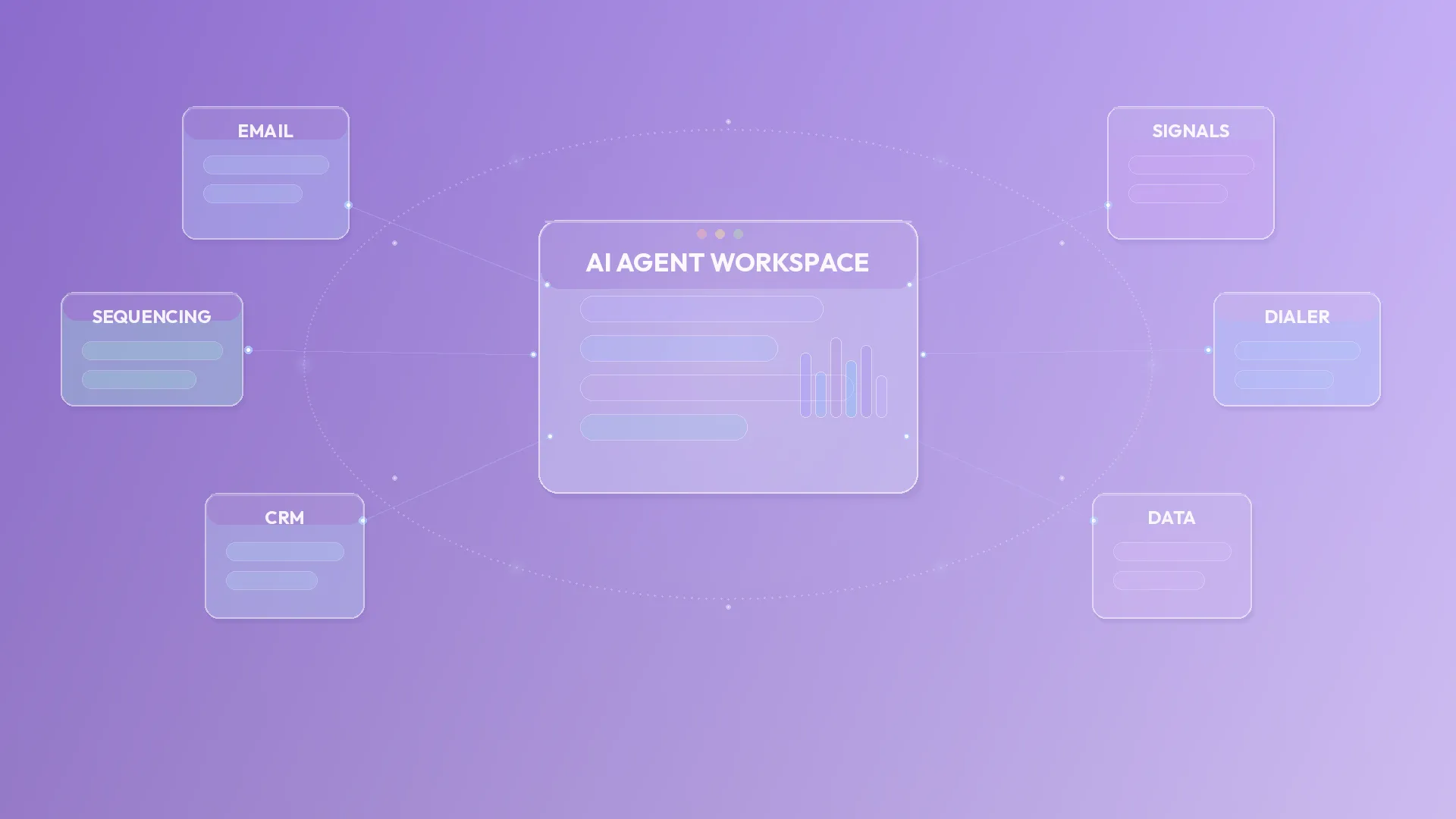
Companies that have moved to Nooks from fragmented stacks consistently describe the same thing: outreach felt disjointed because the underlying data was. Modern AI sequencing platforms are built on unified architectures where the sequencing engine, dialer, and data layer share a single context rather than exchanging it through connectors.
Background Agents That Keep Sequences Current
Traditional sequences require manual maintenance. Someone has to audit which cadences are underperforming, update messaging that's gone stale, enroll new prospects, and pause outreach when conditions change. At most companies, that work falls behind.
AI sequencing introduces background agents that handle this automatically. An agent monitors engagement metrics, flags underperforming steps, and can pause or modify a sequence when a prospect's status changes: a deal reopens in CRM, a new contact joins the account, or a company event changes the relevant angle. Mid-market teams evaluating AI sequencing consistently describe the same problem with their previous tools: sequences that went stale, lost rep trust, and effectively stopped being used. Background agents solve that by making sequence maintenance continuous rather than periodic.
AI Sequencing vs. Legacy Sequencing
Who Benefits Most From AI Sequencing
AI sequencing has the most impact on teams running high-volume outbound with SDR or BDR teams who've invested in a traditional SEP and hit the ceiling on what it can do.
SDR and BDR managers feel the problem most directly. Stale sequences and low adoption are the top complaints at this level. Reps stop using cadences when the messaging feels irrelevant or canned. AI sequencing gives managers a way to keep content current without running a manual audit every quarter. The AI handles what's changed; the manager handles what requires judgment.
Directors of Sales and Business Development care most about consolidation. Tool fragmentation shows up as the primary pain point at this level: reps toggling between Salesforce, ZoomInfo, LinkedIn Sales Navigator, their SEP, and a dialer — what Nooks calls the toggle tax — spending time on coordination that should go to conversations. Sales directors in documented evaluations have cited reps spending roughly an hour a day on manual prospecting tasks with no assistance from their existing SEP. AI sequencing consolidates that motion into a single workspace.
RevOps and Sales Ops leaders focus on CRM fidelity. The shadow CRM problem — where the SEP maintains its own contact and activity records that conflict with Salesforce — creates reporting failures and strategic blind spots. RevOps leaders evaluating alternatives have consistently cited unreliable Salesforce sync and shadow CRM conflicts as core drivers. AI sequencing platforms built on a CRM-first architecture write directly to Salesforce in real time, keeping the CRM as the actual system of record.
VPs of Sales and CROs look at pipeline coverage. Brian DeRosa, VP Global Business Development at HubSpot, reported 67% more meetings booked per BDR after switching to Nooks AI Sequencing. For a team of 10 to 30 SDRs, that kind of shift in per-rep output compounds into material pipeline impact without adding headcount.
What to Look for in an AI Sequencing Platform
Not every AI sequencing platform delivers the same thing. Some are automated cadence tools with an AI email writer attached. Others are built from the ground up on signal-driven architecture. The distinction matters.
Signal integration depth. The value of AI sequencing depends on what signals the system can actually see. Platforms should ingest CRM activity, email engagement, call outcomes, third-party intent data, and company news in a single context layer. A tool that reads only email opens and click-throughs is automating, not adapting.
Zero-draft quality. AI-generated outreach should reduce work, not create new edit cycles. The best platforms generate drafts a rep can approve in under two minutes, not drafts that require full rewrites to be usable. Ask to see generated examples from real prospect accounts during any evaluation.
Native CRM integration. If the platform maintains its own database of contacts and activity separately from Salesforce, you're recreating the shadow CRM problem the tool was supposed to solve. Look for bidirectional, real-time sync that treats your CRM as the primary system of record.
Unified dialing and sequencing. Call outcomes are among the most valuable signals for adapting a sequence. If your dialer and sequencing tool live in separate systems, call data stays siloed. Platforms that handle both can update the sequence automatically based on what happened on the call.
Deliverability infrastructure. Sending more email through AI sequencing puts pressure on your domain's reputation at scale. Without built-in placement testing, bounce management, and send-rate controls, higher volume leads to higher spam rates. This is often an afterthought in evaluation that becomes an operational problem later.
Frequently Asked Questions
What is AI sequencing?
AI sequencing is an outbound sales approach where AI agents monitor buying signals, generate personalized outreach drafts, and adapt the sequence based on observed prospect behavior. It replaces time-based cadences — where outreach fires on a fixed schedule regardless of what the prospect has done — with signal-based triggers that fire when a prospect shows genuine buying intent.
How does AI sequencing differ from automated sequencing?
Automated sequencing (traditional Outreach or Salesloft cadences) schedules a fixed series of touchpoints in advance and sends them on a timer. AI sequencing monitors prospect behavior and external signals to determine when to reach out, what to say, and which channel to use. The difference is between a sequence that fires regardless of context and one that responds to it.
What is a zero-draft in outbound sales?
A zero-draft is an AI-generated message built from available prospect context — CRM history, call recordings, company news, intent signals — that a rep receives instead of a blank template. The rep reviews and refines rather than writing from scratch. The goal is to collapse the research-and-writing phase into a short review cycle.
What counts as a buying signal?
A buying signal is any observable action that suggests a prospect may be evaluating solutions. Common examples: visiting a pricing or product page, a company posting a senior sales hire, a prospect engaging with competitor content, a renewal date approaching in CRM, or a trigger event like a funding round or leadership change. AI sequencing platforms monitor these signals and use them to time and tailor outreach.
Does AI sequencing replace SDRs?
No. AI sequencing shifts what SDRs spend time on, not whether SDRs are needed. Research, writing, and list management get handled by AI; SDRs spend more time on conversations and strategic decisions. Teams that deploy AI sequencing report more prospect conversations per rep, not fewer reps.
What's the difference between AI sequencing and a sales engagement platform?
A sales engagement platform (SEP) is the broader product category. Traditional SEPs like Outreach and Salesloft use automated cadences: scheduled touchpoints sent on a timer. AI sequencing is an approach within that category that requires a different architecture — signal integration, unified context, and adaptive workflows. For the full category history and how the SEP has evolved from task-management software to agent workspace, see What Is a Sales Engagement Platform?
What should I evaluate in an AI sequencing platform?
Signal integration depth, zero-draft quality, native CRM sync, unified dialing and sequencing, and deliverability infrastructure. The core question in any evaluation: does the platform adapt outreach based on live signals, or does it automate a pre-set schedule? The former is AI sequencing; the latter is an automated cadence with better copy tools.
Final Thought
"Sequencing platform" spent a decade meaning Outreach or Salesloft — tools built on scheduling infrastructure that was genuinely useful for its time. AI sequencing starts from a different premise: knowing when to reach out, based on what the prospect is actually doing, is as important as what you say.
Nooks AI Sequencing brings together AI-driven sequencing, a parallel dialer, prospecting intelligence, and AI coaching in one Agent Workspace for Sales, giving teams a unified context layer to run the full outbound motion. If you're evaluating what AI sequencing looks like in practice, that's where to start.