
The 7 Best RevOps Tools and Platforms in 2026 Compared

.webp)
RevOps doesn't close deals, but it shapes almost everything the people who do closing actually see. It decides what data lands in front of reps, how pipeline gets forecasted, how comp gets paid, and whether the activity happening in outbound ever makes it into the numbers leadership trusts. The tools a RevOps team runs are how that influence reaches the sales floor. Pick the wrong ones and sales executes against a distorted picture. Pick the right ones and the whole revenue motion gets more predictable.
The category is also in flux. "RevOps," "revenue operations," and "revenue intelligence" get used interchangeably, and the tools filed under each label run the range from forecasting platforms to CRM automation to conversation intelligence. Ask five operators what a "RevOps tool" is and you'll get Gong, Clari, HubSpot, Zapier, and a spreadsheet. That ambiguity is worth naming up front, because the right stack depends on which of those jobs your team actually owns.
This guide covers the tools worth knowing across the jobs a modern RevOps team is responsible for: forecasting, pipeline and deal management, compensation, workflow automation, data enrichment, and conversation intelligence. For each one, here's what it does well, where it stops, and how the choice shapes what your sales team can execute day to day. No single tool on this list does all of it, and any vendor claiming otherwise is selling a feature list, not an operating system.
One variable runs underneath the entire list: CRM data integrity. Most RevOps pain traces back to two versions of the truth, and the truth usually starts diverging at the outbound layer, where the highest volume of activity gets created. Keep that in mind as you read, because it's the difference between a stack that gives RevOps influence over sales execution and one that just gives RevOps more to reconcile.
Key Takeaways
- A RevOps stack spans roughly six jobs: forecasting, pipeline and deal management, compensation, workflow automation, data enrichment, and conversation intelligence. Each one is deep enough to be its own category, and each shapes a different part of how sales executes.
- The tools that show up repeatedly in RevOps recommendations (Clari, Gong, Clay, Weflow, QuotaPath, Zapier) are each strongest in one job rather than trying to own the whole stack.
- CRM data integrity is the quiet problem underneath the whole list. Tools that sync to Salesforce on a delay, or build a separate database alongside it, create the reconciliation work RevOps spends hours on every month, and they distort the forecast sales leadership is trying to trust.
- The outbound execution layer is where the most CRM data gets created, which is why RevOps cares about it even though it isn't a traditional "ops" tool. Nooks sits here: it turns that activity into next actions for reps, not just clean records, and it's CRM-first by design so the insight is grounded in live data.
The 7 Best RevOps Tools in 2026
The list leads with the outbound execution layer, where the most CRM data originates, then moves through the tools that forecast, coach, enrich, and automate on top of it. Each entry names what the tool does, its standout capability, and the sales team it's built to serve. A forecasting tool and a comp tool aren't competing for the same slot, so read the order as the flow of data through the stack, not a head-to-head quality rank.
1. Nooks: Best for Keeping the Outbound Layer CRM-First
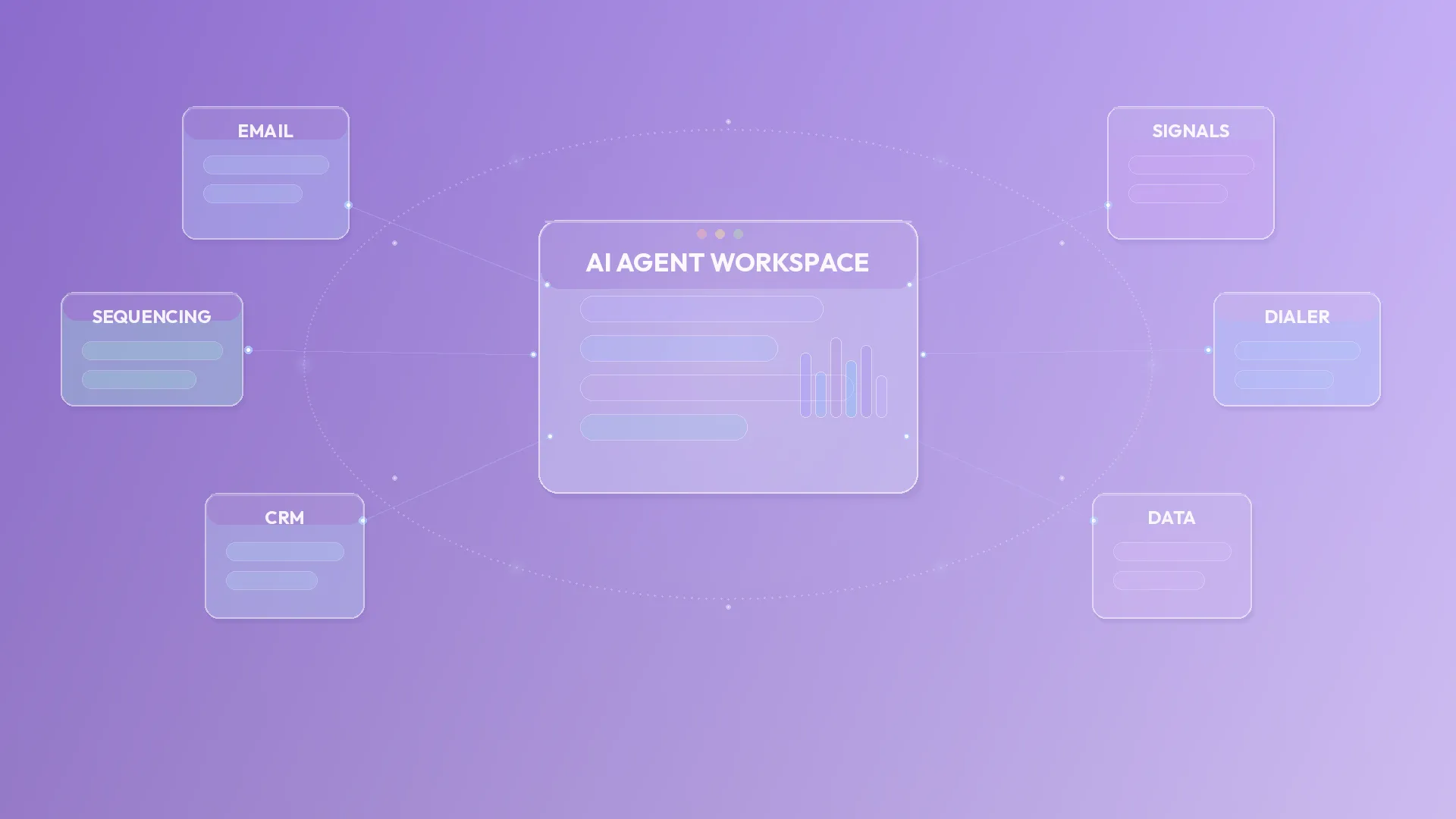
Nooks is a revenue agent platform, not a RevOps ops-stack tool in the same sense as the six below. It doesn't forecast, run comp, or manage a deal desk. Its main functionality for RevOps is the AI Assistant, which pulls together prospecting, dialing, sequencing, and coaching data from one workspace and turns it into a next action a rep can run: who to call, what to say, what to send. RevOps cares about that because the outbound layer is where the highest volume of CRM activity gets created, and Nooks is built to turn that activity into insight, not just records to reconcile.
Key features:
- AI Assistant that turns prospecting, dialing, sequencing, and coaching data into one next action per rep, not a task list to sort through
- AI Prospecting signals... so it knows who's worth reaching, not just who's on a list
- AI Sequencing and AI Dialer activity feed the assistant, so it knows what's already happened...
- AI Coaching call data feeds the assistant, so recommendations reflect what's actually working for that rep, not a generic script
- CRM-first architecture underneath all of it: the assistant reasons over live Salesforce data, not a shadow copy
Best for: RevOps teams that want the outbound layer to hand reps a next action instead of a data log for someone else to report on.
Here's the RevOps-relevant angle. Legacy sales engagement platforms sync to Salesforce on their own schedule and build a shadow CRM alongside it, which is a common source of the reporting gaps RevOps ends up fixing by hand, especially the outbound data gap in revenue intelligence that appears when top-of-funnel activity never makes it into the forecast. Nooks removes that reconciliation work at the source. If a stack already has its forecasting, comp, and enrichment tools, the remaining question RevOps should ask is narrower: is the outbound layer creating a signal reps can act on, or just data to clean up?
2. Clari: Best for Forecast Accuracy at Scale
Clari is a forecasting platform many large RevOps teams standardize on. It aggregates CRM and activity data into a forecast meant to be more reliable than a rep's gut call, and surfaces deal risk before it shows up in a missed quarter.
Key features:
- AI-based forecast projections that update as pipeline changes
- Deal-risk scoring that flags stalled or slipping opportunities
- Pipeline inspection across teams, segments, and time periods
- Activity capture that ties rep behavior to deal outcomes
- Revenue reporting built for board- and leadership-level review
Best for: RevOps and sales leadership teams that need forecast accuracy and deal-risk visibility across a large, complex pipeline.
Clari shapes how sales runs its forecast calls and where managers spend inspection time. Its accuracy is only as good as the CRM data feeding it, which is why the integrity of upstream activity data matters as much as the model itself.
3. Gong: Best for Conversation Intelligence
Gong is the most established conversation intelligence platform: call recording, transcription, and deal-risk signals pulled from what's actually said on calls rather than what gets typed into the CRM afterward.
Key features:
- Automatic call and meeting recording with transcription
- Deal-risk and sentiment signals from conversation content
- Coaching insights based on real rep-buyer interactions
- Pipeline and deal reviews grounded in call data
- Market and competitor intelligence pulled from conversations
Best for: RevOps and sales leadership that want visibility into deal health and rep performance beyond what's logged in the CRM.
Gong influences how managers coach and how deals get inspected. Its strength is the conversation intelligence layer, reading what's said on calls; it isn't the CRM-first system of record for the outbound activity that generates them.
4. Clay: Best for Flexible Data Enrichment
Clay pulls from dozens of data providers into a single spreadsheet-style interface that RevOps and GTM teams use to build, enrich, and clean prospect and account lists with custom logic rather than a fixed feed.
Key features:
- Enrichment from dozens of data sources in one workflow
- Custom formulas and logic for list building and scoring
- Waterfall enrichment that falls back across providers
- AI research agents for account and contact data
- Integrations that push enriched data into the CRM and outbound tools
Best for: RevOps and GTM teams that need flexible, custom enrichment logic instead of a single fixed data provider.
Clay shapes the quality of the data sales acts on before a rep ever reaches out. Its output is only useful if it lands cleanly in the CRM and the outbound layer downstream.
5. Weflow: Best for Pipeline Hygiene in Salesforce
Weflow focuses on pipeline and deal management inside Salesforce itself, giving reps and managers a faster interface for updating and reviewing deals without adding a separate reporting layer on top of the CRM.
Key features:
- Fast deal updates from a single Salesforce-native view
- Pipeline inspection and deal-review workflows
- Activity capture that keeps Salesforce current automatically
- Custom deal fields and notes kept in the CRM
- Pipeline reporting built on live Salesforce data
Best for: RevOps teams that want cleaner deal hygiene and higher CRM adoption without bolting on another system of record.
Weflow influences how reliably the pipeline reflects reality, which is upstream of every forecast and board number. It keeps the CRM current at the deal level; it doesn't touch top-of-funnel outbound activity.
6. QuotaPath: Best for Compensation Management
QuotaPath owns compensation: calculating commissions, modeling comp plans, and giving reps visibility into what they're owed without a spreadsheet reconciliation every payout cycle.
Key features:
- Automated commission calculation tied to CRM deal data
- Comp plan modeling and scenario testing
- Rep-facing earnings visibility and forecasting
- Approval workflows and payout reporting
- Integrations with CRM and finance systems
Best for: RevOps and finance teams that currently manage comp manually or in spreadsheets and want fewer payout disputes.
Comp is one of the most direct levers RevOps has on sales behavior: pay on the wrong metric and reps optimize for the wrong thing. QuotaPath makes that lever precise, provided the CRM data it calculates against is accurate.
7. Zapier: Best for Workflow Automation
Zapier is the connective tissue of most RevOps stacks: no-code automation that moves data between tools so it doesn't have to be re-entered by hand. It isn't RevOps-specific, but it shows up constantly as the glue between purpose-built systems.
Key features:
- No-code automation across thousands of app integrations
- Multi-step workflows triggered by CRM or tool events
- Data routing and formatting between systems
- Error handling and monitoring for automations
- AI steps for lightweight enrichment and routing
Best for: RevOps teams stitching a stack of purpose-built tools together without dedicated engineering support.
Zapier shapes how fast data moves through the revenue stack. It's powerful glue, but glue between systems that each hold data differently can also propagate a bad record everywhere at once, so what it connects matters as much as that it connects.
How We Evaluated These RevOps Tools
We didn't rank these on feature counts. A RevOps tool earns a place in the stack when it owns a real operational job and makes the revenue motion more predictable rather than adding another login. The criteria that mattered:
- Owns a real job, not a feature list. Forecasting, comp, enrichment, and conversation intelligence are each deep enough to be their own category. A tool that claims all of them usually does none of them well.
- Respects the CRM as the source of truth. Tools that copy CRM data into their own database instead of referencing it live create the exact reconciliation problem RevOps exists to prevent.
- Has a clear internal owner. Tools with no obvious owner (whose job is it to maintain this?) go stale within a year regardless of how good they are.
- Shapes sales execution measurably. The best RevOps tools change what reps do or what leadership sees, not just what gets stored. If a tool can't be tied to a rep behavior or a leadership decision, it's overhead.
- Integrates without creating a second system of record. Every added database is another place for the truth to split.
How to Choose the Right RevOps Tool
The right stack depends on which jobs your team owns and where your data is currently breaking. A few decision points matter more than the feature comparison.
Start With Where the Data Breaks, Not the Category
Most teams shop by category ("we need a forecasting tool") when the real problem is that the forecast is wrong because the underlying activity data is incomplete. Trace a reporting problem back to its source before buying the tool that reports on it. Often the fix is upstream, at the layer creating the data, not the layer displaying it.
Prioritize CRM-First Architecture
Any tool that maintains its own database instead of referencing the CRM directly creates two versions of the truth. RevOps is usually the team that discovers the discrepancy and the team that has to reconcile it. Ask every vendor whether they write to the CRM in real time or sync on a schedule, and whether they build a separate record store. The answer predicts how much reconciliation work the tool will create.
Treat AI as a Baseline Requirement, Not a Nice-to-Have
AI in a RevOps tool used to be a differentiator; in 2026 it's close to table stakes. The gap that matters now is between tools where AI reads signals and recommends a next action, and tools where "AI-powered" just means a summary bolted onto a static dashboard. Ask what the AI actually changes: does it flag a next best action, or just describe what already happened? A forecasting tool that scores deal risk before a rep misses it, an assistant that drafts the next call script from live signals, or an enrichment tool that builds and prioritizes lists instead of running a fixed feed: that's the bar. Anything short of that is reporting with an AI label on it.
Match the Tool to How It Changes Sales Behavior
RevOps influences sales through the tools it deploys: comp plans change what reps chase, forecasting rhythms change how managers inspect, enrichment changes who gets contacted. Choose tools by the behavior you want to change, not the dashboard you want to look at.
Consolidate Within a Category, Not Across
Consolidation is real, but it happens inside a category (one forecasting tool, one comp tool) more than across them. Be skeptical of any single platform claiming to replace your entire stack. Depth in one job beats shallow coverage of six.
What's Shaping the RevOps Tooling Conversation in 2026
Three shifts are worth tracking as you build or revisit a stack this year.
The taxonomy is still settling. "RevOps," "revenue operations," and "revenue intelligence" are converging on overlapping tool sets, and buyers increasingly search across all of them for the same underlying job. Expect the labels to keep blurring before they consolidate, which means the smartest teams evaluate by the job to be done, not the category name on the website.
CRM-first architecture is becoming the dividing line. As AI writes more activity data automatically, the gap between tools that reference the CRM live and tools that maintain a shadow copy is widening. The shadow-CRM problem gets worse, not better, as data volume grows.
The outbound execution layer is being pulled into the RevOps remit. RevOps used to stop at the CRM boundary. As outbound becomes the largest single source of activity data, the quality of that layer is now a RevOps concern, not just a sales-team preference.
Final Thought: The Best RevOps Stack Starts With Clean Data
The tools on this list each own a real job, and the strongest RevOps stacks combine a few of them rather than betting on one platform to do everything. But the pattern underneath the whole list is data integrity. Forecasting, comp, and conversation intelligence are all only as good as the CRM data they run on, and that data is created upstream, in the execution layer where reps actually work.
That's where Nooks fits a RevOps conversation. It turns the signals outbound generates into a next action a rep can run, and it does that CRM-first, so the insight feeding every other tool in the stack is grounded in live data rather than reconciled after the fact. If your forecast keeps breaking on incomplete top-of-funnel data, that's the layer worth looking at. Request a demo.