What Is an AI Sales Agent? (Plus the Best AI Sales Agents in 2026)

.webp)
An AI sales agent (sometimes searched as an AI agent for sales) is software that uses AI to perform sales tasks autonomously or semi-autonomously: researching accounts, drafting and sending outreach, qualifying leads, booking meetings, and in some cases running full conversations, without a human doing that step by hand. Some AI sales agents operate with no human review at all. Others work alongside reps, handling the research and drafting while a person still owns the conversation.
That distinction, autonomous versus human-in-the-loop, determines what an agent is actually good at, and where it breaks.
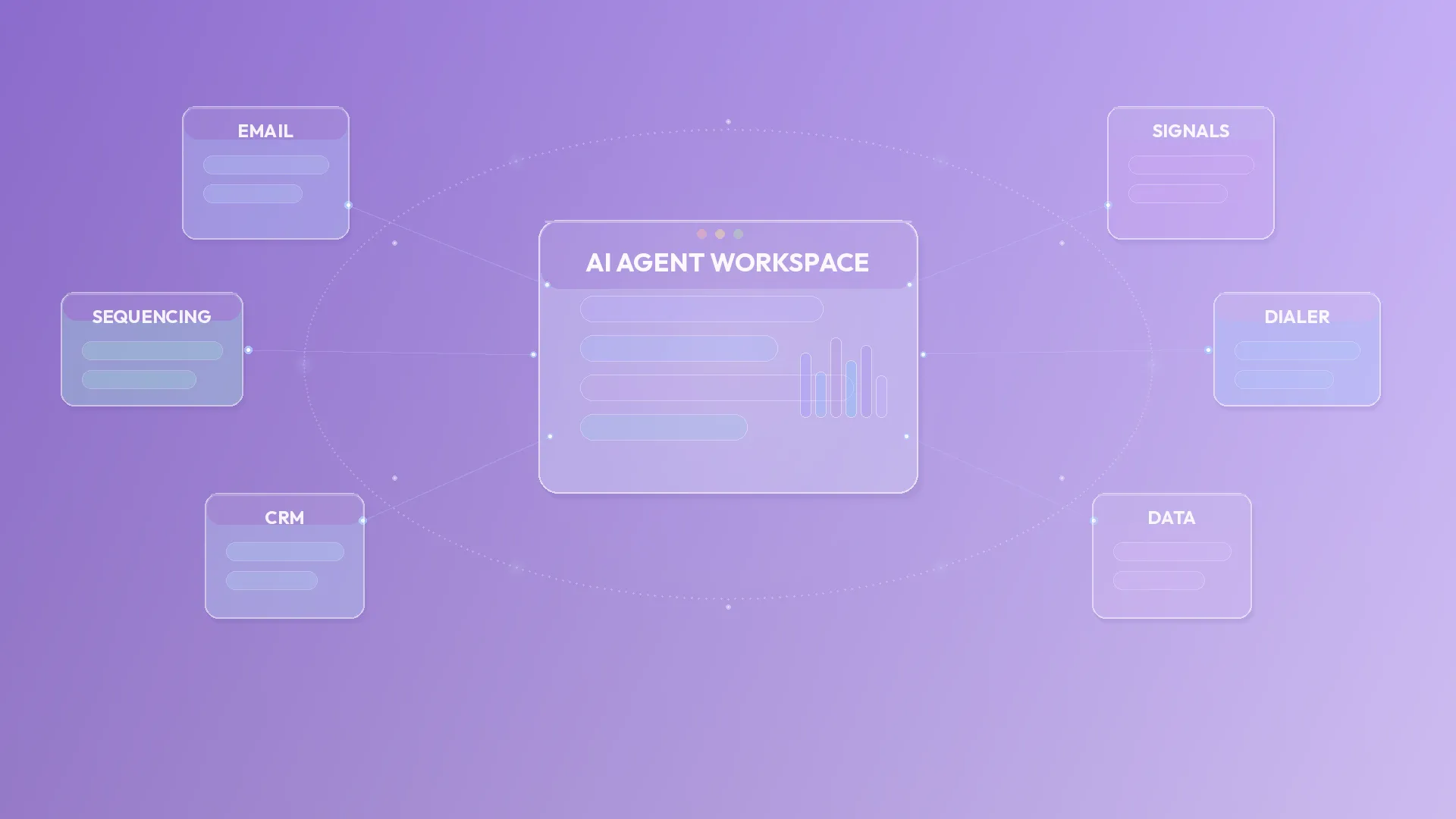
An AI sales agent platform is a single system where several AI agents work alongside human reps across the outbound workflow, from signals and sequencing to dialing and coaching. A single-purpose sales automation tool handles one of those jobs in isolation. On Nooks, AI Sequencing personalizes outreach from calls, CRM data, and buying signals, and Signals and Intelligence retrains its scoring models from call outcomes.
Key Takeaways
- An AI sales agent can mean two very different things: a fully autonomous system that runs outbound with no human involvement, or an AI layer that supports a human rep who still owns the conversation.
- Autonomous agents optimize for volume. Human-in-the-loop models optimize for conversion. Neither is universally "better," they fit different motions.
- The best AI sales agents in 2026 span both models, from fully autonomous point tools to unified platforms where AI and reps work side by side.
- Nooks customers including Greenhouse (933% cold-call pipeline increase, 7x more connects in the first three days) and HubSpot (59% more live conversations, 24% pipeline productivity uplift per BDR), use AI Dialer and AI Coaching with reps on the calls.
What Is an AI Sales Agent?
An AI sales agent applies natural language processing, machine learning, and automation to tasks a human rep would otherwise do manually: researching a prospect, writing a first-draft email, qualifying a lead against ICP criteria, sequencing follow-ups, and in the most autonomous versions, holding the conversation itself over chat, email, or voice.
The term gets used loosely because the underlying products vary enormously in how much autonomy they actually have. A tool that drafts an email for a rep to review and a tool that emails, calls, and books a meeting with zero human involvement are both marketed as "AI sales agents." Knowing which one you're evaluating changes everything about what to expect.
Two Types of AI Sales Agents
Autonomous AI sales agents run the sales motion independently: researching, writing, sending, and following up with little or no human review. The pitch is scale, one agent doing outbound work that would otherwise take a team. This model works best for high-volume, lower-stakes motions where a slightly generic touch doesn't sink the deal.
Human-in-the-loop AI sales agents handle the research, drafting, and prioritization, then hand the output to a rep who makes the judgment calls: what to say, when to call instead of email, how to handle an objection that doesn't fit a script. The AI removes busywork; the human still runs the relationship.
The execution gap between the two shows up fastest in mid-market and enterprise deals, where a fully autonomous agent can't know that a prospect just left a competitor, that their VP mentioned a specific pain point last week, or that a fourth AI-drafted email is about to burn the account. Judgment calls like that are still a human strength, and they show up directly in close rates.
What AI Sales Agents Are Used For
AI sales agents are most commonly applied to six tasks: prospecting and lead scoring, outreach drafting, meeting booking, qualification, call support, and post-conversation follow-up.
- Prospecting and lead scoring: surfacing and ranking accounts most likely to convert, based on CRM history and real-time signals
- Outreach drafting: writing personalized first-draft emails and sequences from account and signal data
- Meeting booking: autonomous agents in particular are often built specifically to handle scheduling back-and-forth
- Qualification: running discovery-style questions over chat or voice to filter leads before they reach a human rep
- Call support: surfacing battlecards, account research, and suggested talking points in real time during live calls
- Post-conversation follow-up: drafting recap emails, updating CRM records, and queuing next steps automatically
Benefits of AI Sales Agents
Done well, AI sales agents give reps back the hours that used to go to research, drafting, and admin, so more of the day goes to actual conversations. Drata saw a 25% increase in meetings booked after adopting Nooks' human-in-the-loop model. The upside compounds because AI-prioritized outreach also tends to be better targeted, so reps spend that reclaimed time on the right accounts first.
The tradeoff shows up when autonomy outpaces judgment. Fully autonomous agents that draft and send without review can produce outreach that reads as generic at scale, and a burned prospect from a bad autonomous touch damages every future touchpoint with that account.
AI Sales Agent Platforms vs. Single-Purpose Sales Automation Tools
Single-purpose sales automation tools each do one job, such as dialing, email sequencing, or scheduling, and leave the rest of the workflow to the rep or to other tools. An AI sales agent platform covers several of those jobs in one system. Three differences follow from that.
- Workflow coverage: A platform spans several stages, such as signals, sequencing, dialing, and coaching. A single-purpose tool covers one of them.
- Context sharing: On a platform, one stage can draw on data from another. On Nooks, AI Sequencing personalizes outreach from calls, CRM data, and buying signals. Across separate tools, reps carry that context from one system to the next themselves.
- Learning from outcomes: A platform can feed results from one stage back into another. On Nooks, Signals and Intelligence retrains its scoring models from pickups and objections, so call results improve targeting.
The Best AI Sales Agents in 2026
This list spans both models, autonomous point agents and unified platforms, because they solve different problems. Look at what each one automates and who reviews the output before deciding which fits your motion.
Nooks: An AI sales agent platform. AI agents and human reps working the same accounts together, rather than a single autonomous agent replacing the rep. AI handles signal detection, prospecting, email drafting, call prep, and post-call logging; reps own every conversation. Greenhouse saw a 933% cold-call pipeline increase, 4x more dials, and 7x more connects in its first three days; HubSpot saw 59% more live conversations and a 24% pipeline productivity uplift per BDR. The fit is mid-market and enterprise outbound teams that want AI-driven efficiency without giving up rep-led judgment on live conversations. It's not a fit for teams that want to remove reps from the outbound motion entirely; every conversation still runs through a person.
Artisan (Ava): An autonomous AI sales agent built to run outbound prospecting end-to-end, including research, list building, and email sequencing, with escalation rules you set for when a human steps in. Best fit for teams that want to run Ava alongside their existing stack, with manual touches queued as rep tasks.
11x.ai: Autonomous digital workers including Alice, an AI SDR for outbound, and Julian, an inbound digital worker for lead qualification and meeting scheduling. Best fit for teams that want to consolidate outbound, inbound, and qualification.
Salesforce Agentforce: Salesforce's native AI agent layer inside the CRM, built to automate sales and service tasks within Salesforce specifically. Best fit for teams already deep in Salesforce who want agents that don't require a separate platform.
Clari (now part of Salesloft): Forecasting and pipeline visibility products, including Clari Forecast and Inspect. Useful for RevOps and sales leadership visibility.
Gong: Revenue intelligence with AI agents that surface deal risk and coaching insight from call and email data. Gong Engage prioritizes and personalizes sales engagement.
What to Consider Before Adopting an AI Sales Agent
How much autonomy does your motion actually tolerate? High-volume, lower-ACV, inbound-qualified flows can absorb more autonomy. Complex, high-ACV outbound with a real buying committee generally can't; a misfire costs more than it saves.
Does it create a shadow CRM? Agents that sync to Salesforce on a delay, or maintain a separate database, create duplicate records and reporting gaps. CRM-first architecture, where the agent references live CRM data directly, avoids this.
Can a human catch a bad output before it reaches a prospect? Any agent drafting or sending outreach should have a review layer, or clear guardrails against hallucinated claims. An agent with no brakes is a brand risk at scale.
Does the agent learn from your team's own outcomes, or run generic scripts? Agents trained on your team's actual conversion patterns should outperform generic automation over time.
Ready to see what an AI agent platform looks like for your team? Request a demo.