
The Swivel Chair Tax: Why Your SEP, Dialer, Signals, and Data Must Be Unified

Every morning, a Sales Development Representative sits down at their desk and opens a dozen browser tabs.
They log into an intent data platform to hunt for buying signals. They switch to a data provider to find a mobile phone number. They open a legacy Sales Engagement Platform (SEP) to send a cold email. They open a separate integrated sales dialer to make their calls. Finally, they open their CRM to log their notes and update the account status.
This constant context switching is called the "Swivel Chair Tax."
For years, revenue leaders accepted this fragmented workflow as the cost of doing business. They bought specialized, standalone tools for every single step of the outbound process. But today, this bloated tech stack is the silent killer of SDR productivity.
When your SDRs spend half their day alt-tabbing between disconnected software platforms, they lose their flow state. Worse, they lose the context of the deal. Here is why the fragmented sales stack is failing and how modern teams are reclaiming their time through sales tech stack consolidation.
Fragmented Tools Create Fragmented Intelligence
Legacy sequencing tools were built for a simpler time. They were built when it was impossible to scale relevance.
Today, context lives everywhere. It lives in call transcripts, email replies, LinkedIn engagement, intent platforms, and market news. When you force a rep to use a disjointed stack, you are forcing the human brain to act as the integration layer. The rep has to manually glue all of that context together across multiple tabs.
This breaks the modern outbound model entirely.
If your signal engine does not talk directly to your SEP and dialer integration, you create massive blind spots. An AI that only drafts emails cannot see that the prospect just mentioned a competitor on a cold call yesterday. An intent tool that only flags website visits cannot automatically waterfall a mobile number and push that prospect to the top of a dialing queue.
More importantly, isolated tools cannot learn. When you have standalone software, there is no continuous feedback loop. If a rep handles a competitor objection on a live call, the standalone email tool never learns about it. The intelligence is trapped.
As we say at Nooks: Signals without action create no value. Actions without signals create noise.
The Solution: The Unified Agent Workspace
To eliminate the Swivel Chair Tax, you cannot just integrate your tools with Zapier. You need to fundamentally rethink the workspace.
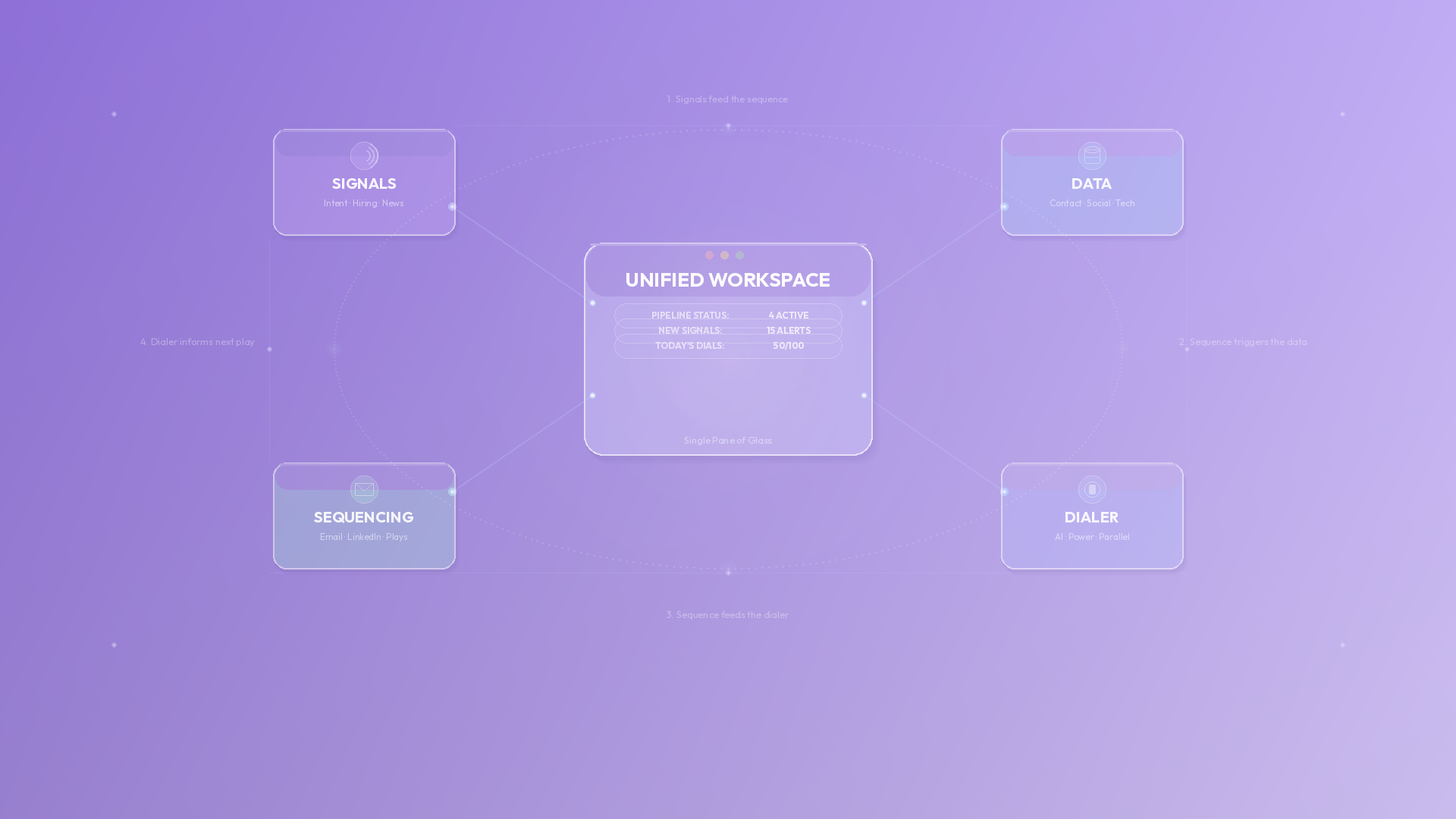
Modern revenue teams are abandoning the Frankenstein tech stack. They are moving to a unified Agent Workspace that brings the four core pillars of outbound into a single, seamless environment: SEP + Data + Signals + Dialer.
Instead of asking human reps to glue tabs together, you deploy a fleet of background agents that share a single continuous feedback loop. When humans and digital agents operate from the exact same memory and coordinate against the exact same goals, outbound becomes intelligent.
Here is how a unified tech stack completely transforms the SDR workflow:
1. Signals Feed the Sequence
In a unified workspace, reps do not manually hunt for intent data. Background agents continuously monitor the market for observable buying signals while your human team sleeps. When a target company posts a relevant job opening, the platform automatically triggers an AI Sequence and drafts a highly personalized email.
2. The Sequence Triggers the Data
You no longer need a separate tab for contact enrichment. Before the sequence executes a step, the background agents automatically waterfall the prospect's data across multiple premium providers. They ensure the rep always has a verified mobile number and a clean email address right when they need it.
3. The Sequence Feeds the Dialer
This is the ultimate consolidation play. A modern SEP natively includes a high-velocity AI Dialer. If a prospect engages heavily with an email, the sequence dynamically reprioritizes that account. The background agents instantly push the prospect to the #1 spot in the rep's dialing queue.
4. The Dialer Informs the Next Play (The Feedback Loop)
When the rep executes the call, the AI transcribes the conversation in real time. It logs the notes directly into the CRM. More importantly, this triggers a powerful continuous feedback loop. The background agents use the context of that live call to dictate the exact next step in the sequence. If the prospect asks for a follow-up in three weeks, the agents automatically pause the sequence and schedule the exact right play based on the human interaction.
Conclusion: Stop Paying the Tax
Sales tech stack consolidation is not just an exercise for the CFO to save money on software licenses. It is a strategic mandate to unlock your sales floor.
If you ask your reps to stitch together a signal tool, a data provider, an email sequencer, and a standalone dialer, you are actively draining their selling time. You are paying a massive Swivel Chair Tax every single day.
Stop buying disconnected software. Upgrade to a unified Agent Workspace. Give your reps a single pane of glass where signals, data, sequencing, and dialing all work together effortlessly. Empower your reps to manage a digital workforce fueled by continuous feedback loops. When you remove the friction, you unlock the pipeline.