Top 5 Apollo Alternatives for Outbound Sales in 2026


Updated April 2026
Most teams using Apollo hit the same ceiling: the database is full but sequences send generic messages, calls never inform future outreach, and no one can connect activity to pipeline. That ceiling exists because Apollo was built for data access, not execution.
This guide ranks five Apollo alternatives for B2B outbound teams ready to move beyond a pure data-access tool. Nooks ranks first among these outbound sales tools because it delivers intelligent outbound by connecting AI agents across sequencing, dialing, prospecting, and coaching in one workspace.
Key takeaways
- This article compares five Apollo alternatives (Nooks, Lemlist, Reply.io, Instantly.ai, and Clay) ranked by outbound execution depth.
- Most Apollo alternatives focus on a single outbound function. Top outbound sales tools unify prospecting, sequencing, dialing, and coaching in one place.
- Among the outbound sales tools in this guide, Nooks ranks first because AI agents work 24/7 to deliver intelligent outbound in one workspace.
- Evaluate outbound sales tools on whether they close the loop between call outcomes and future campaign decisions, not just call volume.
- Apollo is strong as a contact database but lacks the multi-channel execution depth that high-volume outbound teams require.
- Teams consolidating tech stacks should prioritize CRM-native platforms that eliminate data syncing across disconnected tools.
- Outbound success increasingly depends on platforms that adapt campaigns based on live call data rather than static contact records.
Top Apollo alternatives for outbound sales: quick compare
Use this comparison to identify which outbound sales tools align with your team's execution needs, CRM requirements, and growth stage. Rankings prioritize execution depth, workflow integration, and the ability to connect prospecting, sequencing, dialing, and coaching in a unified system.
1. Nooks — top Apollo alternative
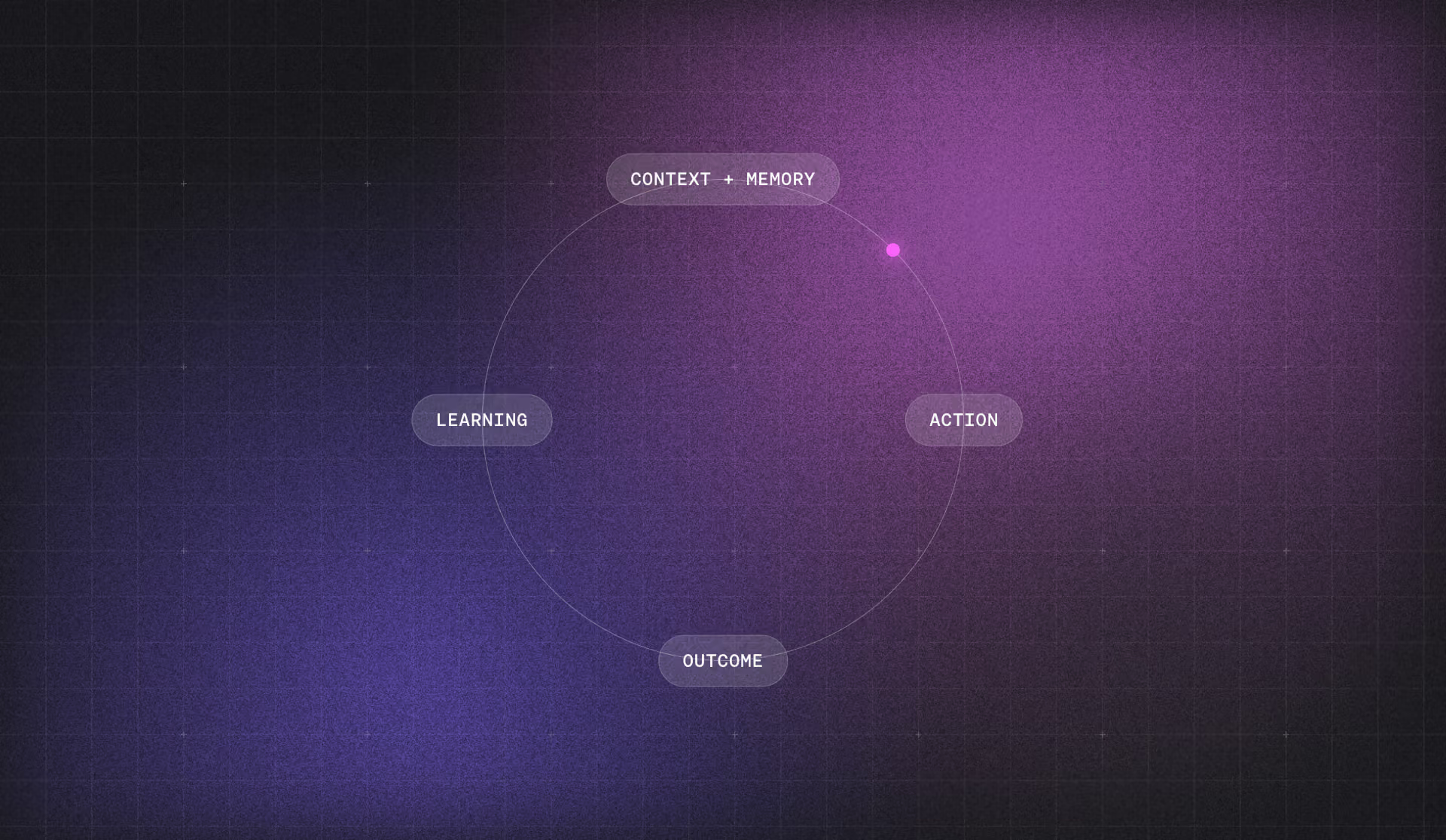
Nooks is an AI-native agent workspace that delivers intelligent outbound by connecting sequencing, dialing, prospecting, and coaching in one unified workspace. AI agents custom-trained to think like your best reps work 24/7 to handle research and data enrichment while reps focus on conversations. Call outcomes continuously improve AI agent prioritization without reps switching between disconnected tools.
Key features:
- AI-powered parallel dialing: AI agents run multi-line dials simultaneously and drop voicemails automatically, keeping reps in live conversations.
- 24/7 prospecting agents: AI agents research and enrich contacts around the clock, surfacing who to call and why before reps dial.
- Call-to-sequence feedback loop: Call outcomes directly adjust sequence steps so messaging adapts based on real conversations.
- Unified coaching workspace: Reps review recordings, practice roleplay, and run dials in one interface without switching between tools.
- Pipeline-connected rep insights: Manager dashboards connect call activity to deal progression, showing which outbound behaviors drive revenue.
Best for: Outbound sales teams consolidating tech stacks who need prospecting, dialing, sequencing, and coaching integrated in one AI-native workspace.
2. Lemlist
Lemlist is an outbound sales tool focused on cold email personalization and sequence management. It lets sales reps add custom images and videos to email campaigns and includes inbox warm-up and deliverability features.
Key features:
- Email personalization: Inserts custom images, text snippets, and variables into cold email templates for each recipient.
- Deliverability tools: Provides warm-up sequences and inbox rotation to manage email sender reputation.
- Sequence automation: Offers multi-step email sequences with branching logic triggered by recipient behavior.
Best for: SDRs and small sales teams running email-first outbound campaigns who need strong personalization features and deliverability controls without enterprise-level pricing or contracts.
3. Reply.io
Reply.io is a sales engagement tool that supports email, phone, LinkedIn, SMS, and WhatsApp outreach within a single sequence. It targets SDRs who want multichannel coverage with automation options across several outreach channels.
Key features:
- Multichannel sequences: Combines email, phone, LinkedIn, SMS, and WhatsApp steps in one outreach workflow.
- Template library: Offers a library of pre-built sequence templates for common outbound sales use cases.
- AI writing assistant: Generates draft email copy for sequence steps based on simple text prompts.
Best for: SDRs and small sales teams looking for multichannel outreach sequences across email, LinkedIn, and phone without enterprise pricing or added complexity.
4. Instantly.ai
Instantly.ai is a cold email platform that focuses on high-volume sending with inbox management and deliverability features. Users can connect unlimited email accounts and rotate sending across multiple inboxes to manage overall sending volume.
Key features:
- Unlimited sending accounts: Supports connecting multiple email accounts to scale cold email sending volume.
- Inbox warm-up: Automatically warms new email addresses to establish sender reputation before campaigns begin.
- Campaign analytics: Tracks open rates, reply rates, and bounce rates across active sending campaigns.
Best for: Agencies and solo founders running high-volume cold email campaigns who prioritize deliverability and inbox management over conversation-based outbound.
5. Clay
Clay is a data enrichment and workflow automation tool built for sales operations teams constructing targeted outbound lists. It pulls contact and company data from more than 50 enrichment sources and uses AI to research accounts at scale.
Key features:
- Waterfall enrichment: Queries multiple data providers in sequence to fill in contact and company record fields.
- AI research agent: Uses AI to search and summarize account information from public web sources.
- CRM workflow automation: Connects enriched contact data to CRM records and outreach platforms through no-code workflows.
Best for: Sales operations and RevOps teams building highly targeted outbound lists who need waterfall data enrichment from multiple providers.
How to choose the right outbound sales tools for your team
Choosing among Apollo alternatives requires more than comparing feature lists. The right platform depends on your team's execution gaps, CRM requirements, and how tightly you need calling, coaching, and sequencing to work together.
Assess where reps are actually spending their time.
Sales teams evaluating Apollo alternatives should start by mapping where reps spend most of their time. If the majority goes to list management, data entry, or switching between tools, the issue is execution depth not data coverage. Look for outbound sales tools that automate the busywork so reps stay in conversations.
Prioritize platforms that connect dialing to coaching.
Many outbound tools treat dialing and coaching as separate activities with no connection between them. The strongest platforms use call data to inform coaching and future sequences. Outbound sales tools that close this loop, like Nooks, connect live conversations to rep improvement through shared call data and continuous feedback.
Check for CRM-native architecture.
Outbound sales tools that maintain separate databases create shadow CRM issues when they don't sync bidirectionally with Salesforce or HubSpot in real-time. Teams end up managing duplicate records and reconciling conflicting data across systems. Platforms with bidirectional CRM sync write activity data directly to your CRM immediately so every call, sequence step, and coaching note stays in one authoritative system without manual reconciliation.
Evaluate whether the platform scales with your team.
Tools built for solo SDRs often lack the manager visibility and performance analytics that sales leaders need at scale. Before committing, verify the platform supports territory management, team-level reporting, and the ability to roll out playbooks across the entire sales org. A platform that cannot grow with you will require a costly migration later.
Look for adaptive sequences, not static automation.
Most email-first Apollo alternatives treat sequences as set-it-and-forget-it workflows. The best outbound execution platforms update sequence steps based on call outcomes, engagement signals, and account intelligence. Static automation may look efficient, but it stops improving after the first send while adaptive sequences get sharper with every conversation.
What trends are shaping outbound sales in 2026?
- Only 28% of a sales rep's workday goes to actual selling activities, according to. The remaining 72% is consumed by admin tasks, manual logging, and switching between tools.
- AI applied to sales prioritization and outreach can produce 15–20% improvements in pipeline conversion. The gap widens significantly for teams still running manual prospecting workflows.
- It takes an average of eight follow-up touches to secure an initial sales conversation. Single-channel outbound tools leave most of those touches uncoordinated or unconverted.
- 76% of top-performing salespeople consistently use CRM tools, compared to 47% of underperformers. Platforms with bidirectional real-time sync ensure CRM data stays current and accurate, making it more valuable for reps to actually consult and rely on.
- 85% of sales professionals say AI tools make them more effective at their jobs. For teams still manually managing prospects across disconnected tools, that effectiveness gap translates directly into lost pipeline and slower ramp time.
Final thought: Nooks is the top alternative to Apollo for outbound sales in 2026.
Selecting among Apollo alternatives comes down to deciding how much of the outbound workflow you want inside one system, and no outbound sales tool delivers this more completely than Nooks. For teams still bouncing between a contact database, a dialer, a sequencer, and a coaching tool, the switching cost is real and the feedback loops never close.
Nooks delivers intelligent outbound by giving teams an AI-native agent workspace where AI agents handle research, enrichment, and execution around the clock while reps stay focused on conversations. For outbound teams serious about performance, Nooks is not just the best Apollo alternative. It is the platform that makes the rest of the stack unnecessary.
Frequently asked questions
What are outbound sales tools?
Outbound sales tools are platforms that help sales teams execute prospecting, sequencing, dialing, and coaching in a coordinated workflow. Unlike point solutions that handle a single channel, the best outbound sales tools connect multiple execution layers so call data, email performance, and coaching all inform each other. Most modern platforms include AI to automate research and campaign execution.
How does Nooks compare to Apollo for outbound sales?
Among outbound sales tools, Nooks stands apart as an AI-native agent workspace built for complete outbound execution while Apollo is primarily a contact database with basic engagement features. Nooks connects prospecting, sequencing, dialing, and coaching in one system where AI agents work 24/7. Teams relying on Apollo alone typically still need separate tools for dialing and coaching, creating fragmented workflows.
How do Apollo alternatives differ in their approach to multi-channel outreach?
Apollo alternatives range from email-only tools like Lemlist and Instantly.ai to multichannel platforms like Reply.io to AI-native workspaces like Nooks. The key difference is integration depth. Nooks sequences adapt based on live call data, while most other Apollo alternatives treat sequencing as a standalone email automation function without feedback from real conversations.
Can Nooks work for smaller outbound sales teams, or is it designed for enterprise?
Nooks is designed as an enterprise-grade platform that also works for growing B2B companies running structured outbound motions. The AI-native agent workspace reduces the manual effort typically required so smaller teams can operate with the efficiency of larger ones. Teams typically get the most value when running consistent call volume and systematic prospecting rather than sporadic campaigns.
How do I choose the best outbound sales tool to replace Apollo?
Start by identifying which part of your outbound workflow Apollo fails to support: execution depth, coaching, or dialing. Then evaluate each platform based on whether it covers all of those gaps or just one. Teams replacing Apollo for a complete outbound motion will get the most value from platforms that unify prospecting, sequencing, dialing, and coaching in one system.
What makes Nooks different from the other outbound sales tools in this comparison?
Nooks is the only platform in this comparison that operates as a unified AI-native agent workspace across sequencing, dialing, prospecting, and coaching. Other platforms on this list focus on one or two outbound functions. Nooks AI agents work continuously to execute campaigns and surface prioritization insights while the other tools here require manual orchestration across separate products.