What is an AI Dialer? (Scaling Outbound Without Sacrificing Relevance)


If you look at the data across modern B2B sales floors, a clear trend emerges: outbound math is getting harder. Response rates are compressing, and buyer fatigue is at an all-time high.
To solve this, revenue leaders historically turned to technology that could increase activity. Parallel dialers became the gold standard, allowing reps to call multiple numbers simultaneously and drastically increase their daily connect rates. This was a massive operational win—it eliminated the dead time of listening to endless ringing and voicemails.
However, as the market has grown noisier, high-velocity dialing has exposed a new challenge: volume without targeting can be a liability. If a rep is using a powerful parallel dialer to blast through an untargeted list of cold accounts without any context, they aren't just wasting their breath—they are actively burning through your Total Addressable Market (TAM).
To build pipeline today, sales teams need both velocity and relevance. Enter the AI Dialer.
An AI dialer doesn't replace the need for high-volume efficiency; it perfects it. By mechanizing account research, surfacing real-time buying signals, and automating post-call administrative work, an AI dialer ensures that every single fast-paced dial is highly targeted and contextualized.
Here is what a true AI dialer is, how it evolves the parallel dialing motion, and why it is the engine powering Intelligent Outbound.
The Evolution: From Raw Volume to Intelligent Outbound
When evaluating outbound technology, it is helpful to think of a parallel dialer as a high-performance engine. It provides incredible speed and power. But a powerful engine still needs a navigation system to ensure it's driving in the right direction.
The Limitation of Untargeted Volume
When a rep uses a legacy dialer from other vendors to call a completely cold, static list, they are dropped into live conversations with zero context. They don't know if the prospect's company just laid off 10% of their staff, or if they just hired a new VP of Operations. Forced to guess, the rep defaults to a generic, template-driven pitch. The dialer did its job perfectly—it got the prospect on the phone—but the lack of data targeting caused the conversation to fail.
The AI Dialer as the Navigation System
An AI dialer acts as the intelligence layer wrapped around your telephony engine. It dictates who gets called and why, right now. Instead of relying on static lists, an AI dialer integrates deeply with your data sources to prioritize accounts based on observable reality.
It marries the raw efficiency of parallel dialing with the surgical precision of data-driven targeting.
The 3 Core Pillars of a True AI Dialer
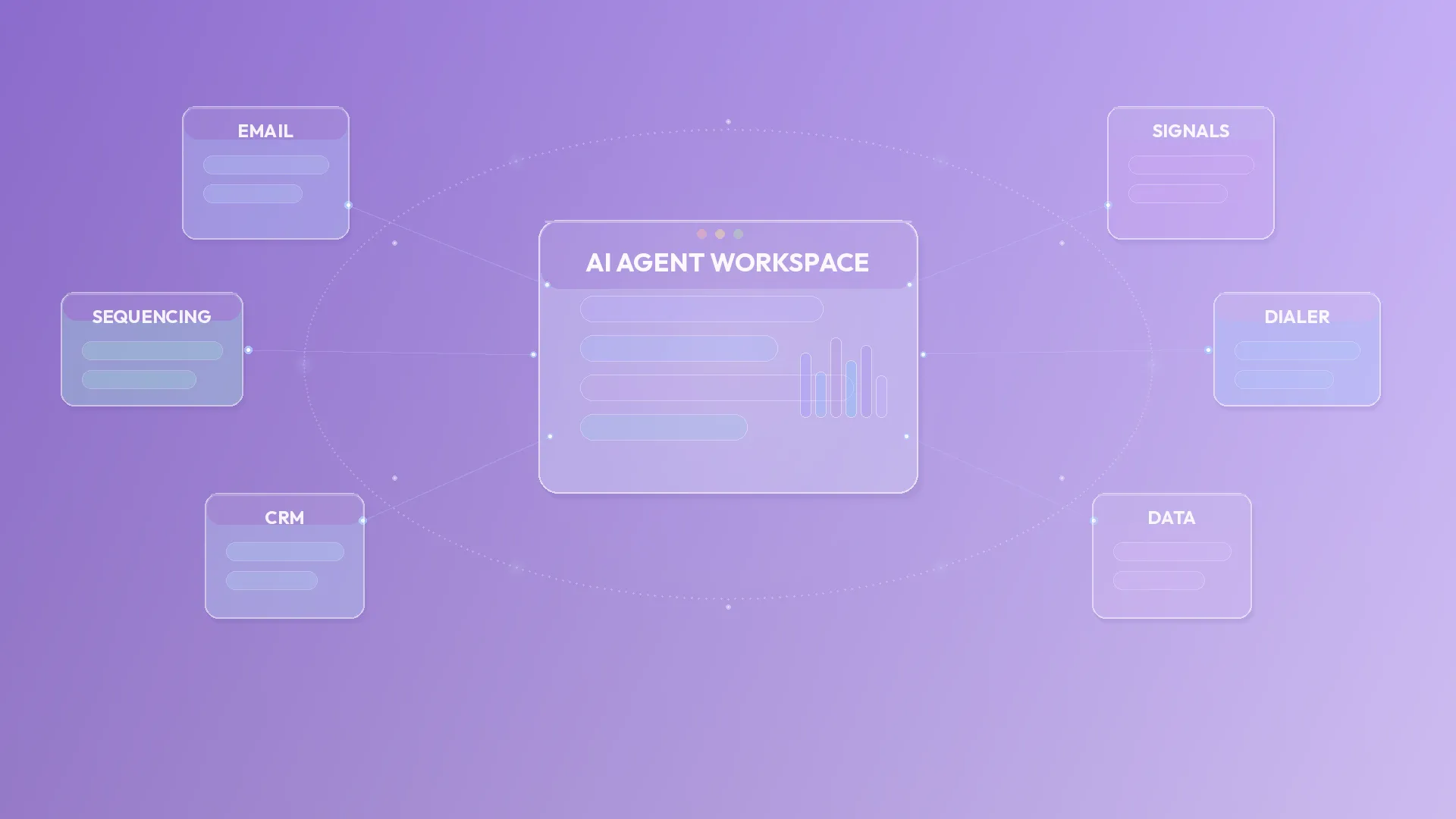
The best AI dialers operate as a complete "Agent Workspace," eliminating the need for reps to switch between a CRM, a sequencing tool, and a spreadsheet just to make a targeted call. This workspace is built on three distinct pillars.
1. Pre-Call: Prioritizing the "Golden Signal"
The hardest part of a successful cold call is the manual research required to find a compelling reason to reach out.
A modern AI dialer automates this research phase, acting as an advanced radar for your sales floor. Before the dial ever happens, the AI agent scans target accounts for observable signals—a newly posted job description mentioning a specific software stack, a keyword in a recent 10-K filing, or a champion who just changed jobs.
The AI dialer then prioritizes the call list based on these real-world artifacts. When the rep connects, they aren't guessing. They can immediately say, "I’m calling because I saw your recent job post prioritizing CRM consolidation..." This is how you make high-volume dialing feel like bespoke, 1-to-1 outreach.
2. Live-Call: The AI / Human Handshake
When the prospect answers, the AI transitions from a researcher to a live co-pilot.
This is the "AI / Human Handshake." The human rep owns the empathy, the active listening, and the strategic maneuvering. The AI owns the real-time enablement. As the conversation happens, the AI dialer transcribes the audio, detects competitor mentions, and surfaces live battle cards to help the rep handle objections smoothly.
If a prospect pushes back with a specific technical constraint, the AI instantly provides the rep with the talking points to pivot the conversation, completely eliminating the "deer in the headlights" moment that often ruins high-speed dials.
3. Post-Call: Reclaiming the Golden Hours
Time saved dialing is easily wasted if a rep has to spend 15 minutes manually updating the CRM after a great conversation. Rewriting call notes, updating disposition codes, and logging activities can consume up to 20% of a rep's day.
An AI dialer reclaims these "golden hours." The moment the rep hangs up, the AI instantly generates a highly accurate summary of the call, extracts the next steps, logs the activity, and updates the relevant fields in your CRM natively.
By eliminating administrative busywork, sales leaders can redirect those saved hours into high-value, human-centric tasks—like multi-threading into the buying committee or refining their account strategies.
The Pragmatic Checklist: How to Evaluate an AI Dialer
The market is currently flooded with tools slapping the word "AI" onto their websites. If you are a VP of Sales or a RevOps leader evaluating an AI dialer to upgrade your outbound motion, use this checklist to cut through the noise:
- Does it combine high-velocity dialing with signal-based prioritization? Your tool should offer the speed of a parallel dialer, but it must include the data intelligence to prioritize those dials based on observable, real-world signals (not just vague, black-box intent scores).
- Does it consolidate the workspace? If your reps still have to keep LinkedIn, a research spreadsheet, and Salesforce open in different tabs while using the dialer, it is not an intelligent workspace. The dialer must bring the data to the rep.
- Does it write to the CRM natively? AI summaries are only useful if they automatically map to the right fields in your CRM. The AI must handle the data entry flawlessly so your reps never have to play data-entry clerk again.
Conclusion: Marrying Volume and Relevance
The debate in outbound sales is no longer about "quality versus quantity." To hit ambitious revenue targets today, you need both.
Transitioning to Intelligent Outbound means recognizing that volume is only an advantage when it is pointed at the right target. By implementing a true AI dialer, you empower your sales floor with the ultimate combination: the velocity to cover your TAM, and the data-driven intelligence to ensure every single conversation is highly relevant.
Humans are built for strategy, connection, and closing. Technology is built for scale, research, and speed. The AI dialer is the platform that finally lets both do exactly what they do best.