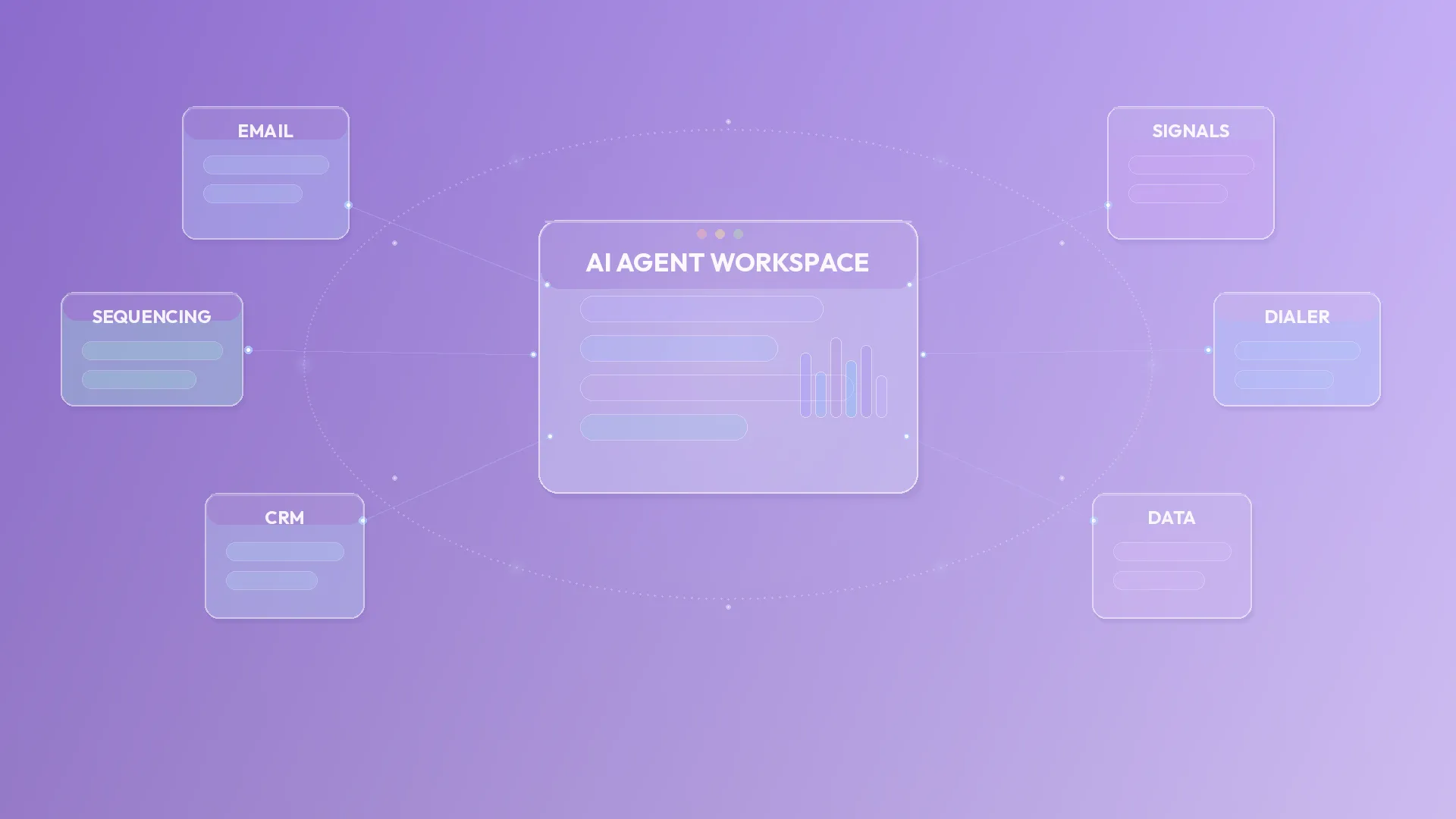

Sales Is a Game of Chess. Can AI Learn to Play?


I recently joined Nooks as Chief Marketing Officer.
Throughout the interview process, I spent a lot of time with Dan, co-founder and CEO of Nooks, talking about what he calls 'the big problems':
- Why has AI transformed how we build products, but not yet how we sell them?
- What makes sales such a difficult problem for AI?
- What would have to be true for agents to become genuinely useful members of a revenue team?
- What would it take to build the future of sales?
These questions don't have one simple answer, and the conversations they sparked fundamentally changed how I thought about agentic AI in sales.
So rather than write another “why I joined” post, Dan and I sat down to continue our conversation on camera.
Nooks CEO Dan Lee and new CMO Loreal Lynch on why selling is one of AI’s hardest problems, the evolution of Nooks from a single product to a Revenue Agent Platform, and what it takes to build a category-defining company.
Why tackle AI for sales?
AI has already changed the economics of building software. Engineers use AI to understand enormous codebases, reason through problems, generate and test code, and iterate faster than ever before.
Sales is different. It doesn’t operate in the binary, right and wrong, 0 or 1.
Selling requires more than knowing the right answer; it requires understanding people, navigating ambiguity, interpreting context, choosing the right action, executing it at the right moment, and adapting based on what happens next.
In that sense, sales is less like solving an equation and more like playing chess. The right move depends on the state of the board—and the board changes constantly.
Sales teams don’t have an intelligence problem
Over the last decade, the revenue technology stack has gotten incredibly good at producing and capturing intelligence. Sellers can surface accounts showing intent, people with recent job changes, conversations mentioning competitors, at-risk deals, which reps have the most success.
All of that intelligence is useful, but knowing what to do and actually doing it are two very different things:
- Knowing which account to prioritize doesn’t engage the buyer
- Knowing a deal is at risk doesn’t move it forward
- Knowing what your best reps do differently doesn’t scale automatically to other sellers
The bottleneck in sales isn’t intelligence. It’s execution.
That’s where we believe Revenue Agents will fundamentally change how revenue organizations operate.
Agentic revenue execution goes beyond giving sellers another recommended action. It’s a system capable of participating in the work of selling itself; executing alongside humans, learning from what happens, and improving over time. We have strong conviction that this is what the future of sales looks like.
From a single product to a Revenue Agent Platform
Nooks began with a focused problem: helping sales teams have more high-quality conversations. We deliberately focused on driving value at the top-of-funnel with SDR teams, proving out the quality and consistency with our AI-powered dialer. But that was only one piece of the revenue workflow.
Today, Nooks is rapidly evolving into a broader platform for revenue execution, helping teams prospect, engage buyers, accelerate deals, coach sellers, and automate work across the revenue lifecycle.
Revenue teams have historically assembled their technology stacks from dozens of disconnected point solutions. One tool finds the buyer, another provides the intent data, another sequences the outreach, yet another records the conversation. Deal analysis, coaching, reporting all might live on different platforms as well. Sales teams navigate 5+ tools to catch and close one deal.
Agents create the possibility of a very different architecture. When the system can participate in the work rather than simply record or analyze it, those workflows begin to converge.
That’s the opportunity behind Nooks.
Build vs. buy in the age of AI
The big question in enterprise AI right now is not whether companies should build or buy software and agents—in fact, most leading enterprise companies already do both. Frontier models make it remarkably easy to build intelligent agents, workflows, and proprietary intelligence. The harder question is: what should you build yourself, and what should you build on?
That’s where the architecture matters. Not just what you build, but how you build it.
Nooks provides the execution infrastructure for revenue: the system agents need to reliably take action across prospecting, engagement, deals, coaching, and the broader revenue lifecycle.
And revenue execution is only the first layer.
Agents built on Nooks develop operational context that a general-purpose model doesn’t have: what’s happening across your accounts, prospects, conversations, reps, workflows, and outcomes. It’s not just what your GTM strategy documents say should happen, but how your organization actually operates day-to-day. That context compounds when every action creates a feedback signal. Nooks learns how your company sells: who you target, what works, what doesn’t, how your best reps operate, which actions lead to outcomes, and how those patterns change over time.
That’s what makes the path toward increasingly autonomous execution so interesting. The system isn’t simply getting a smarter underlying model, it’s learning your unique GTM through the work being done every day.
Cursor is a great example of this model. They build proprietary intelligence themselves and connect it to Nooks through MCP. Their agents don’t have to recreate the execution infrastructure or operational context required to run a revenue motion; they build on top of it.
We believe the companies that get this architecture right will ultimately be able to move beyond agents that assist sellers toward agents capable of running increasingly complex revenue workflows autonomously. More on that in the months to come!
Why I joined Nooks
I had the rare opportunity to be unusually selective about what I did next.
I wasn’t looking for the flashiest AI story; I wanted extraordinary momentum, a differentiated product with a real moat, customers who genuinely love it, leadership I trusted to execute, and a category opportunity large enough to be worth building.
What I found at Nooks stood out to me. More than 1,800 companies already use the platform, including Deel, Cursor, Replit, HubSpot, Rippling, and Zoominfo. The customer enthusiasm is extraordinary. The company ships at a pace I haven’t seen before. The go-to-market organization operates with incredible rigor. And underneath all of it is a technical vision that completely changed how I think about where sales technology is headed.
The team at Nooks is rethinking what the revenue stack looks like when humans and agents actually do the work together and that’s a fascinating problem to solve.
We’re still early, the technology is evolving, the category is still being defined.
And that is exactly why I wanted to be here.