
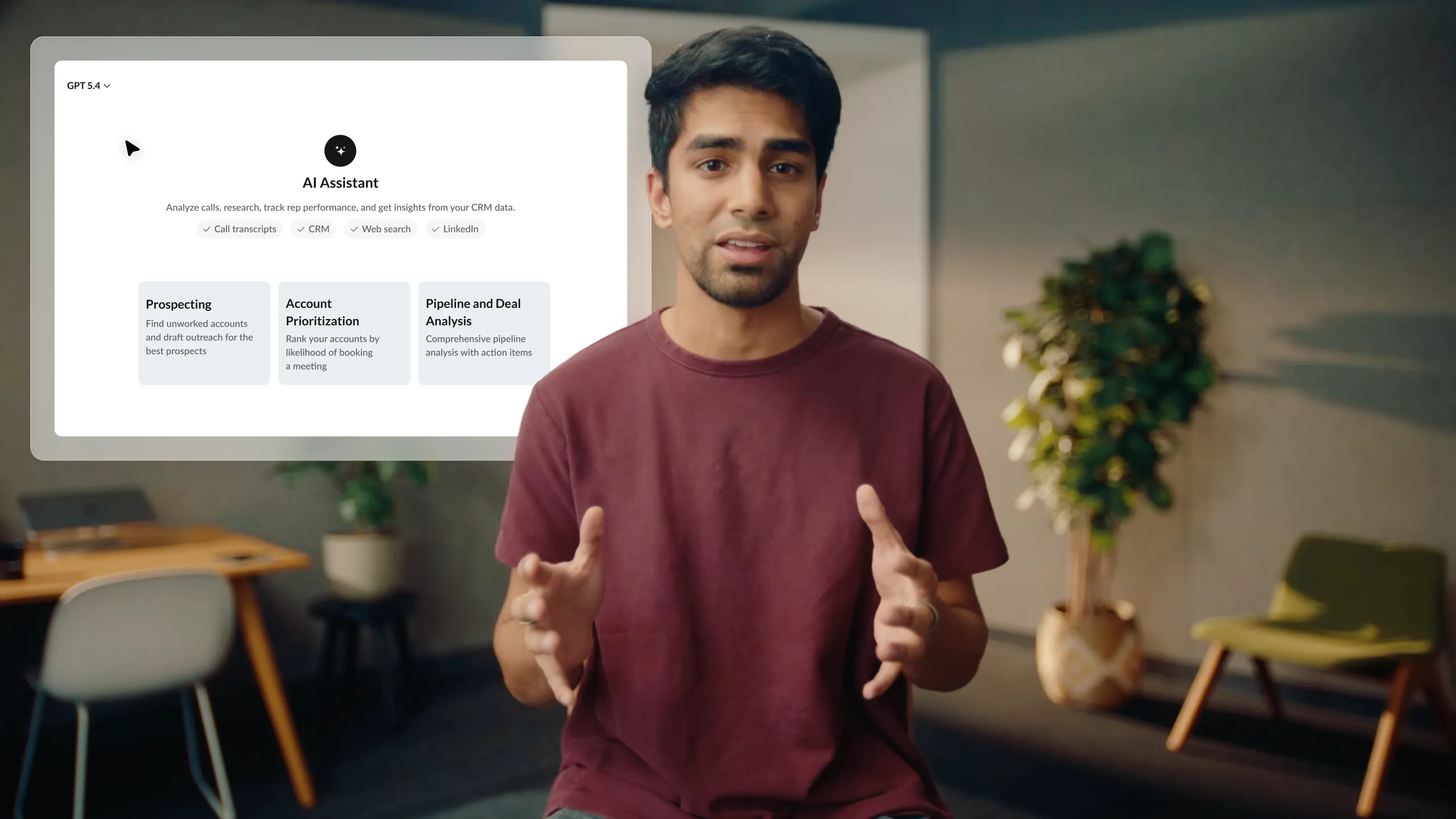
Sales Assistant: What It Really Means Now (and How to Pick the Right One)

If you search “sales assistant” today, you’ll find everything from virtual assistants booking meetings to AI tools promising to write your emails, summarize your calls, and magically fix your pipeline.
Here’s the truth I’ve seen up close: the best sales assistant isn’t the one that “does a little bit of everything.” It’s the one that takes real work off a rep’s plate, in the moments where momentum usually dies. Before the call. During the call. Right after the call. And across the week when you’re trying to stay disciplined.
In other words, a sales assistant should give reps more time in live conversations and help managers build a tighter, more consistent team.
That’s the lens I’m using here. No hype. Just what matters, what to look for, and where Nooks fits in if your world is pipeline and outbound.
What is a sales assistant?
A sales assistant is any tool (or person) that helps sales teams move deals forward by removing friction from the selling process.
Historically, “sales assistant” meant a human who handled coordination: scheduling, list cleanup, CRM updates, maybe some light research. That still exists, but software has started taking over the most repetitive parts.
Now when people say “sales assistant,” they usually mean an AI-powered assistant that can:
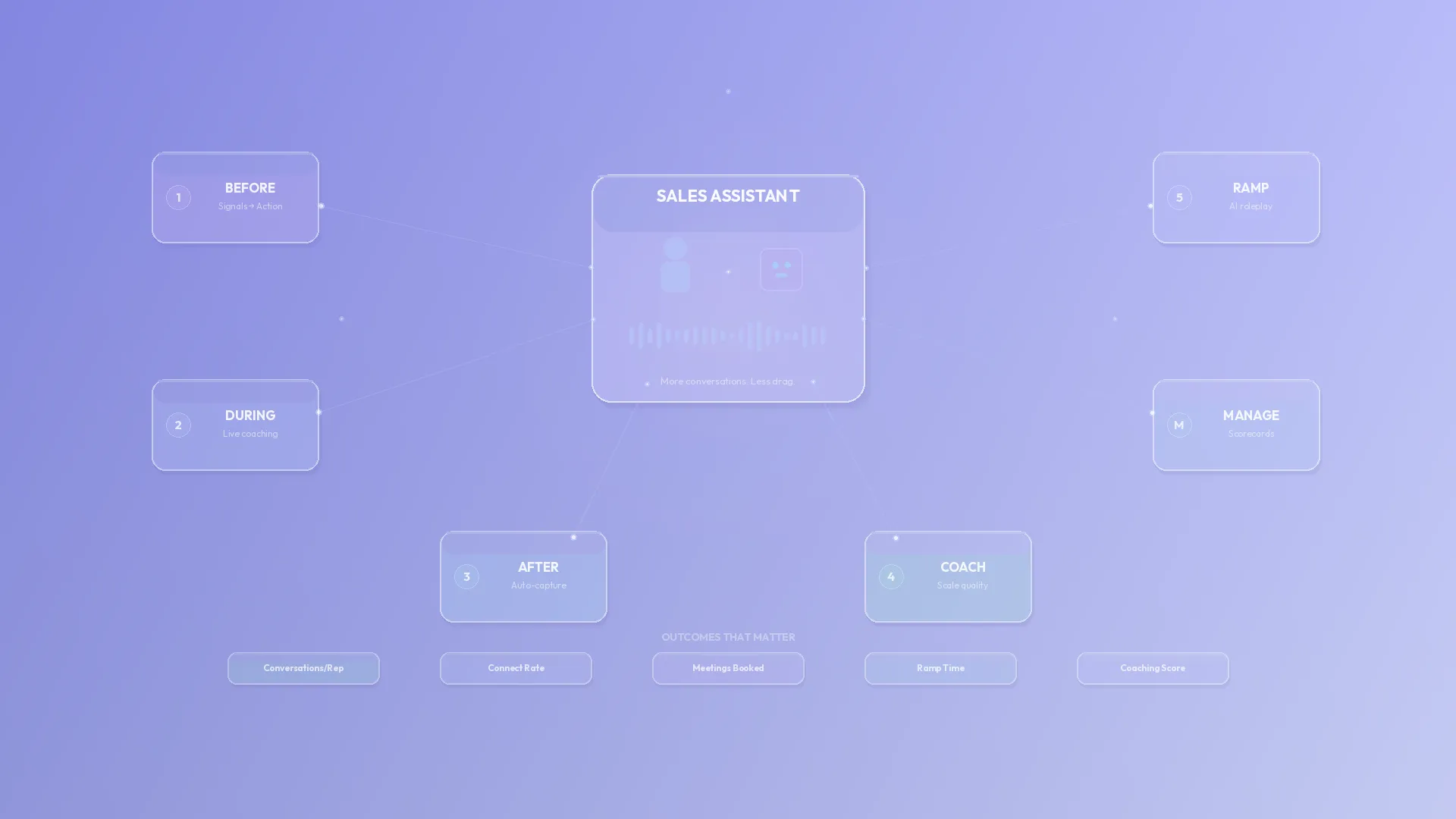
- Prep a rep before outreach (research, context, intent signals)
- Help on the call (coaching prompts, battlecards, live guidance)
- Capture and structure what happened (notes, next steps, disposition)
- Recommend the next best action (follow-up, sequencing, routing)
- Help leaders coach at scale (scorecards, insights, consistency)
Not all of these matter equally. If your team lives on outbound, the biggest unlock is simple: more high-quality live conversations, with less busywork in between.
The real problem a sales assistant should solve
Pipeline isn’t short because reps are lazy. It’s short because the system is full of drag.
Drag looks like:
- Reps spending an hour finding “who to call next”
- Notes and CRM updates piling up until Friday night
- Managers giving coaching based on vibes because they cannot review enough calls
- New reps taking months to sound confident
- Teams doing “activity” without improving connect rate, conversation quality, or meeting conversion
A sales assistant should reduce drag. That’s it. Everything else is window dressing.
If you want a quick gut check, ask this: Does this sales assistant create more selling time, or does it create more admin time in a new interface?
What a modern sales assistant should do (especially for outbound teams)
1) Help reps start fast, not just “get organized”
Most tools obsess over workflows. Reps care about starting the day without confusion.
A strong sales assistant helps answer:
- Who should I contact right now?
- What do I say to open cleanly?
- What’s the one relevant detail that earns me 10 more seconds?
This is where data and signals matter. If the assistant can surface intent, recent changes, past touches, or the right persona to target, reps stop guessing.
Nooks angle: Nooks is built around converting signals into action. The goal is not a prettier dashboard. The goal is turning “we have intent” into “we got a live conversation.”
2) Make calls better in the moment
Coaching after the fact is helpful. Coaching in the moment changes outcomes.
The best sales assistant can support live conversations with:
- Real-time prompts and talk tracks
- Battlecards tied to objections
- Lightweight reminders so reps don’t scramble for notes
This is also where consistency shows up. Your top reps know how to steer a call. Most reps need scaffolding.
Nooks angle: If the call is where value happens, the sales assistant should live close to the call. Nooks focuses on outbound calling performance and coaching, not generic “all sales” abstraction.
3) Reduce the “after-call tax”
The after-call tax is real. It’s the invisible time sink that kills volume and morale: notes, disposition, follow-ups, CRM fields, next steps, and trying to remember what the buyer actually said.
A sales assistant should:
- Automatically capture key moments and next steps
- Draft follow-ups that match what was said (not generic templates)
- Update the CRM without making reps do a second job
When this works, reps finish a call and move to the next one. Momentum stays intact.
4) Help managers coach at scale without becoming call-review robots
Most coaching programs break as soon as the team grows.
A sales assistant should give leaders:
- Simple scorecards that match your actual playbook
- Trend insights across teams, not just individual calls
- Fast ways to spot what’s working and what’s drifting
The goal is not more data. It’s faster clarity.
Nooks angle: Coaching is not a “nice to have” add-on. It’s the only way to scale quality. Nooks leans into that reality with tools designed for SDR leadership rhythms.
5) Accelerate ramp and keep standards consistent
Ramp time is expensive. Every week matters, especially when you are trying to hit pipeline goals in-quarter.
The best sales assistant helps new reps practice before they get on real calls and gives them structured feedback once they start. Think roleplay, scoring, and clear improvement loops.
If you care about enterprise enablement, consistency is the whole game. The assistant should help standardize your pitch across dozens, hundreds, or thousands of reps.
Red flags: when a “sales assistant” is really just noise
I’ve seen teams buy tools that look impressive in a demo but don’t change outcomes. Watch for these patterns:
- It focuses on generating content, not generating conversations
- It requires reps to do more tagging and manual steps than before
- It produces summaries that nobody uses in coaching or pipeline reviews
- It lives outside the rep’s workflow, so adoption drops after week two
- It cannot tie its value to connect rate, conversations, meetings, or opp creation
A sales assistant should show up in metrics that matter. If you can’t see the path from “assistant” to “pipeline,” be careful.
How to choose the right sales assistant: a simple checklist
If I were evaluating a sales assistant for an outbound-heavy team, I’d ask these questions:
- Does it increase live conversations per rep per day?
If it doesn’t move conversations, it’s not doing the core job. - Does it improve meeting quality or conversion?
More meetings is good. Better meetings is better. - Does it reduce admin time after calls?
This is where tools either shine or disappoint. - Does it make coaching easier for managers?
If managers can’t use it weekly, it won’t stick. - Can it scale across teams without becoming complicated?
If it takes a full-time admin to run, adoption will suffer.
Where Nooks fits as a sales assistant
Nooks is a sales assistant built around one outcome: helping sales teams generate pipeline through more high-quality live conversations, with coaching that actually scales.
That means Nooks is especially relevant if:
- Your SDRs or AEs rely on outbound calling
- You care about connect rate, conversations, and meetings booked
- You want coaching to be a system, not a heroic manager effort
- You want signals and prospecting to translate into action quickly
If your main bottleneck is “we need more dials that turn into real conversations,” a sales assistant needs to live in that moment and make it easier, faster, and more consistent.
That’s the philosophy.
The next step: decide what you want your sales assistant to be accountable for
If you take one thing from this post, make it this: stop evaluating a sales assistant on features. Evaluate it on outcomes.
Pick one primary KPI and hold the tool to it for 30 days:
- Conversations per rep
- Connect rate
- Meetings booked
- Ramp time
- Coaching consistency (scorecard adherence, objection handling)
A sales assistant should earn its seat by making those numbers move.
If you want to see what that looks like in an outbound-first workflow, check out: