
Cold Calling Scripts: 12 Openers That Get You Past “What’s This About?”

Cold calling scripts have a branding problem.
Most people picture a robot reading lines while a prospect tries to escape. And honestly, a lot of “scripts” deserve that reputation. They’re stiff, overly clever, and built around the rep’s needs instead of the buyer’s reality.
But in high-performing outbound teams, a cold calling script isn’t a word-for-word monologue. It’s a structure. A few reliable lines that help reps earn the first 10 seconds, find relevance fast, and then turn the call into a real conversation.
That’s what this post is.
These aren’t full scripts from hello to close. They’re openers and first-minute frameworks you can copy, customize, and coach against. If you run an SDR team, this is the part that creates consistency across reps without turning anyone into a script-reading zombie.
And I’ll add something practical at the end: a simple plug-and-play structure for what to say after the opener so your team can connect the dots.
Key Takeaways
Why the opener matters more than the rest
In outbound calling, the first 30–60 seconds decides almost everything:
- Do they give you permission to keep going?
- Do you sound like a human or a pitch?
- Do they hear a problem they recognize?
- Do you ask something easy enough that they’ll answer?
If the opener lands, the rest of the call gets easier. If it doesn’t, it almost doesn’t matter how good the rest of your talk track is. Our data shows permission-based openers convert at 2.4x the rate of standard openers.
That’s why teams obsess over cold calling scripts. They’re really obsessing over the first minute.
What separates a good cold calling opener from a bad one
A bad opener:
- Starts with your company and your title
- Uses buzzwords
- Asks for 30 minutes before earning 30 seconds
- Forces a question that feels like a trap (“Do you have a minute?”)
A good opener:
- Respects their time
- Makes the call about a familiar problem
- Uses plain language
- Earns a tiny “micro-yes” to continue
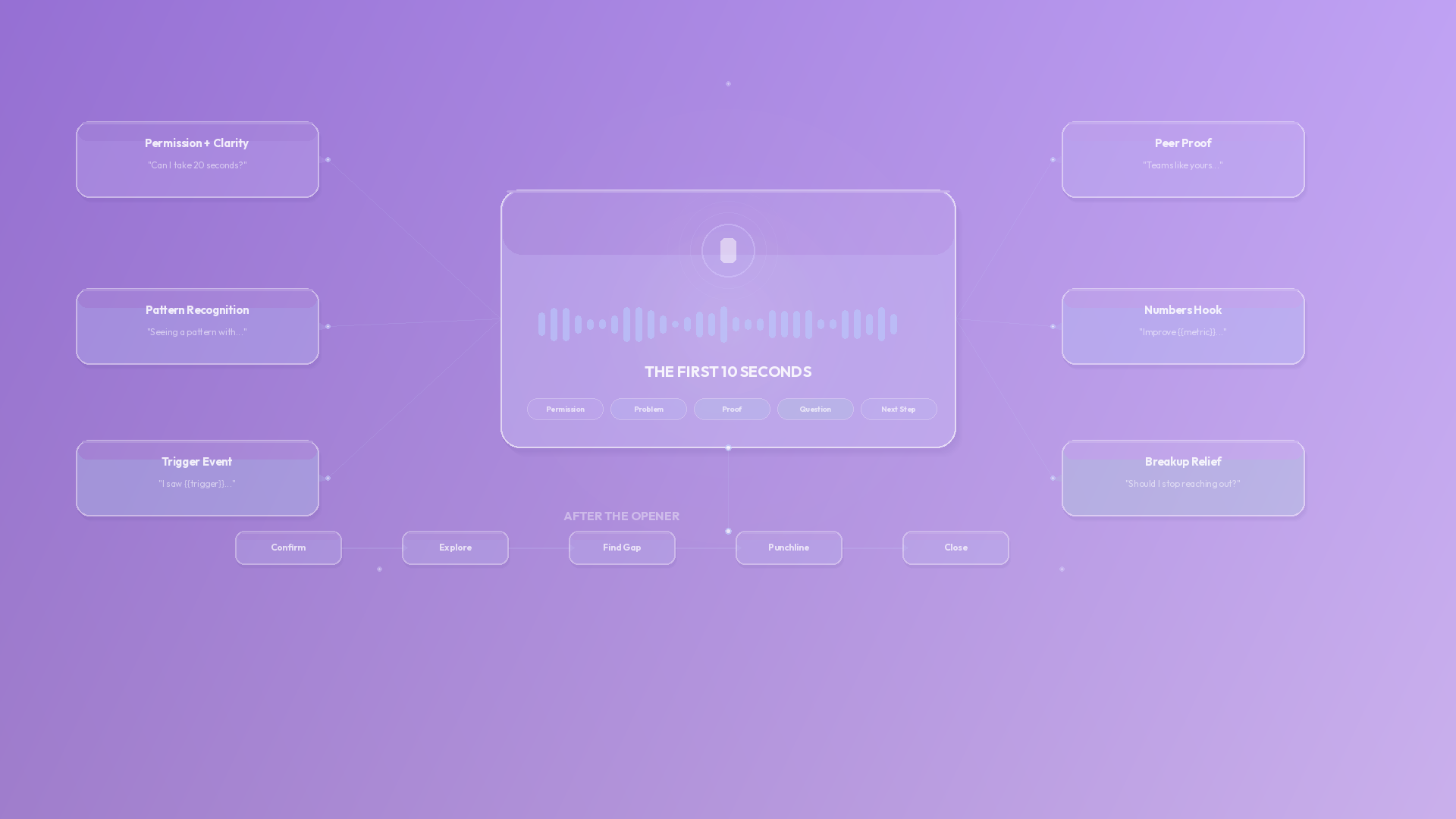
The 5 building blocks of a strong opener
You’ll see these components repeated below. That’s intentional.
- Permission-based start
- Reason for the call, tied to a specific problem
- Light proof (not a brag, just a signal you’re credible)
- Engagement question (easy to answer)
- Micro-next step (continue the convo, not book a demo immediately)
12 cold calling script openers you can use today
1) Permission + clarity (universal)
“Hey {{Name}}, it’s {{Rep}}. I know I’m calling out of the blue. Can I take 20 seconds to tell you why I called, and you can tell me if I’m off base?”
If yes:
“Appreciate it. We work with {{role}} teams who are trying to {{outcome}} without {{pain}}. Quick question: is that even on your radar this quarter?”
2) The “I’ll be brief” opener (when they sound busy)
“Hey {{Name}}. Quick one. I’ll be brief. I’m reaching out because {{reason}}. Are you in the middle of something, or can I ask one question?”
3) Pattern recognition (great for leaders)
“Hey {{Name}}. I’m calling because we’ve been seeing a pattern with {{segment}} teams. Even when activity is up, {{specific issue}} is still dragging pipeline. Are you seeing that too?”
4) Trigger event relevance
“Hey {{Name}}. Calling because I saw {{trigger}}. Usually when that happens, {{problem}} becomes more urgent. How are you handling that right now?”
5) Peer proof (light)
“Hey {{Name}}. I’m reaching out because we work with teams like {{peer group}}. One thing we keep hearing is {{pain in their words}}. Does that sound familiar or am I way off?”
6) Numbers (only if you can defend them)
“Hey {{Name}}. I’ll be quick. We help teams improve {{metric}} without adding headcount. Open to one question about how you’re measuring outbound performance right now?”
7) Coaching angle (for SDR managers)
“Hey {{Name}}. Quick question. When you coach calls, what’s harder: finding the moments worth coaching, or getting reps to apply the feedback the next day?”
8) Ramp angle (enablement)
“Hey {{Name}}. I’m calling because a lot of teams are hiring SDRs, but ramp is still brutal. What’s your target ramp time right now, and are you hitting it?”
9) Breakup tension relief (when you’ve emailed)
“Hey {{Name}}, it’s {{Rep}}. I’ve sent a couple notes and figured it might be easier to ask live. Should I stop reaching out, or is {{problem}} something you’re open to revisiting later?”
10) Wrong person?
“Hey {{Name}}. I might be in the wrong place. We help {{role}} teams with {{problem}}. Who owns that on your side?”
11) Two options (avoids dead-end yes/no)
“Hey {{Name}}. Quick question. Are you more focused on improving {{A}} or {{B}} right now?”
Examples: connects vs meeting conversion, speed-to-lead vs follow-up discipline, activity vs quality.
12) Micro-yes meeting ask (soft close)
“Sounds like this is at least relevant. Would it be crazy to do 15 minutes next week? If it’s not a fit, we’ll know fast.”
What to say after the opener: a simple “rest of call” framework
Once an opener gets you past the first minute, you don’t need a theatrical script. You need a path. But the path changes depending on who you're calling — prospecting sales leaders, for instance, requires a completely different approach than reaching a marketing or security buyer.
Here’s a structure I like because it’s coachable and it keeps reps from rambling:
Step 1: Confirm the problem (1 question)
“Got it. When that happens, what’s the impact? Is it mostly {{option 1}} or {{option 2}}?”
Step 2: Explore current approach (1 question)
“What are you using today to handle that? And what do you like about it?”
Step 3: Find the gap (1 question)
“If you could change one thing about that setup, what would it be?”
Step 4: Give a short, relevant punchline (15 seconds)
“Here’s why I called. Teams fix that by {{simple idea}}. In practice it looks like {{one concrete example}}.”
Step 5: Close with a small next step
“If it’s worth it, let’s do 15 minutes and I’ll show you exactly how teams are solving this. If it’s not relevant, we’ll stop there.”
That’s it. Three questions. One short explanation. A clean ask.
The Nooks angle: openers scale when coaching scales
Openers drift over time. New reps improvise. Experienced reps cut corners. Managers get busy. And suddenly your “standard opener” is just a Google Doc no one opens.
What actually scales:
- scorecards tied to what “good” sounds like
- fast feedback loops based on real calls
- live coaching support when reps get stuck
- practice and repetition so new reps don’t learn on prospects
That’s why we built Nooks around the call: more live conversations, less busywork between them, and coaching that doesn’t collapse when the team grows.
Build an opener library your team will use
Instead of chasing one perfect cold calling script, build a small set reps can rotate:
- 3 permission-based openers
- 3 relevance angles (trigger, pattern, peer proof)
- 3 engagement questions
- 2 closes (continue vs 15-minute meeting)
Then coach to those components. You’ll get consistency without turning calls into theatre.