What Is AI Sales Coaching Software? (And What to Look For in 2026)

AI sales coaching software analyzes live and recorded sales calls to identify what a rep did well or poorly, then turns that analysis into real-time guidance, roleplay practice, and team-wide training. It replaces the old model, where a manager could only review one call per rep per week.
Key Takeaways
- AI sales coaching software analyzes calls to surface coachable moments automatically, then delivers that feedback through live prompts, AI sales roleplay, or both, instead of relying on a manager's limited review time.
- The category splits into three modes: post-call analysis, real-time in-call guidance, and roleplay practice built from real calls. Most legacy tools only do the first.
- Reps who rate their coaching as excellent are 50% more likely to hit or exceed quota than reps who don't, and 38% of reps say they rarely or never receive coaching at all.
- The average sales manager now oversees 12.1 reps, up from 10.9 the year before, making manual, call-by-call review mathematically impossible past a small team.
- Nooks connects coaching to the same platform reps use to dial and sequence, so a coaching insight can update the next call script or prospect list directly.
The Problem With Legacy Sales Coaching Software
Most sales coaching still runs on a manager listening to a recorded call and reviewing it later, if there's time. That's the core failure: coaching that happens three days after the call is coaching that arrives after the deal's outcome is already decided. That's the core failure: coaching that happens three days after the call is coaching that arrives after the deal's outcome is already decided.
The gap shows up in the data. Only 27% of reps hit quota. Thirty-eight percent say they rarely or never receive coaching, despite 90% of leaders claiming they coach at least monthly (MySalesCoach, The State of Sales Coaching). Managers aren't lying: they're trying to review recordings on top of pipeline reviews, forecasting, and their own calls, and something gives.
AI sales coaching software exists to close that gap by moving analysis and feedback closer to the moment the call actually happens. See why traditional sales coaching is a bottleneck for the full breakdown of why one-on-one review doesn't scale.
What AI Sales Coaching Software Actually Does
At a functional level, AI sales coaching software does four things a human manager can't do at scale on their own:
- Scores every call, not a sample. Automated call scoring runs on every rep's calls, not just the ones a manager has time to listen to, so skill gaps surface even for reps who never get manually reviewed.
- Surfaces coaching in real time. Live battlecards and objection prompts can appear on a rep's screen while the call is still happening, based on what the prospect just said.
- Builds realistic scenarios from real calls. Instead of generic scripted scenarios, AI sales roleplay is trained on a team's actual objections and buying signals, so new reps practice against what they'll really hear.
- Feeds insights back into training. When a top rep handles a new objection well, the system captures that response and pushes it into the shared battlecards and sales roleplay library for the rest of the team, instead of leaving it in one recording no one else watches.
Platforms vary in how many of these four they actually do well. Some are strong on post-call analysis and weak on real-time guidance; some do sales roleplay but nothing live. That's the first thing to check before assuming "coaching software" means the same thing across vendors.
AI Sales Coaching vs. Conversation Intelligence: What's the Difference?
Conversation intelligence and AI sales coaching overlap but aren't the same category. Conversation intelligence platforms primarily analyze calls for deal risk, competitive mentions, and pipeline forecasting, tools built for sales leaders and revenue operations to understand what's happening across a book of deals. AI coaching tools focus specifically on rep skill development: practice environments, live guidance, and feedback that's meant to change behavior on the next call, not just explain the last one.
Some platforms do both. The distinction matters most when a tool leans entirely toward one: a pure conversation intelligence tool can tell a VP why a deal stalled without ever helping the rep who ran it improve, and a pure coaching tool can build great sales roleplay without giving leadership the deal-level visibility conversation intelligence provides. See the 7 best AI tools for sales team coaching for a ranked breakdown of where each vendor falls on that spectrum.
The Evolution of Sales Coaching
Sales coaching technology has moved through three distinct phases.
Manual review meant a manager listening to a handful of recorded calls per week, if time allowed, and delivering feedback days after the fact from memory and notes.
Post-call conversation intelligence automated the recording and transcription, and added analysis (talk-time ratios, keyword flags, deal risk signals) that's still valuable for deal visibility and forecasting today. For coaching specifically, feedback still arrived after the call ended: coverage went up, but delivery timing stayed the same.
Real-time, AI-native coaching is the current phase: live prompts during the call itself, AI sales roleplay trained on real conversations instead of scripted scenarios, and feedback loops where one rep's winning response becomes training material for the whole team within the same day. The shift matters because behavior change happens closest to the action. A manager coaching a rep on an objection they just heard beats reviewing the same moment three days later in a 1:1.
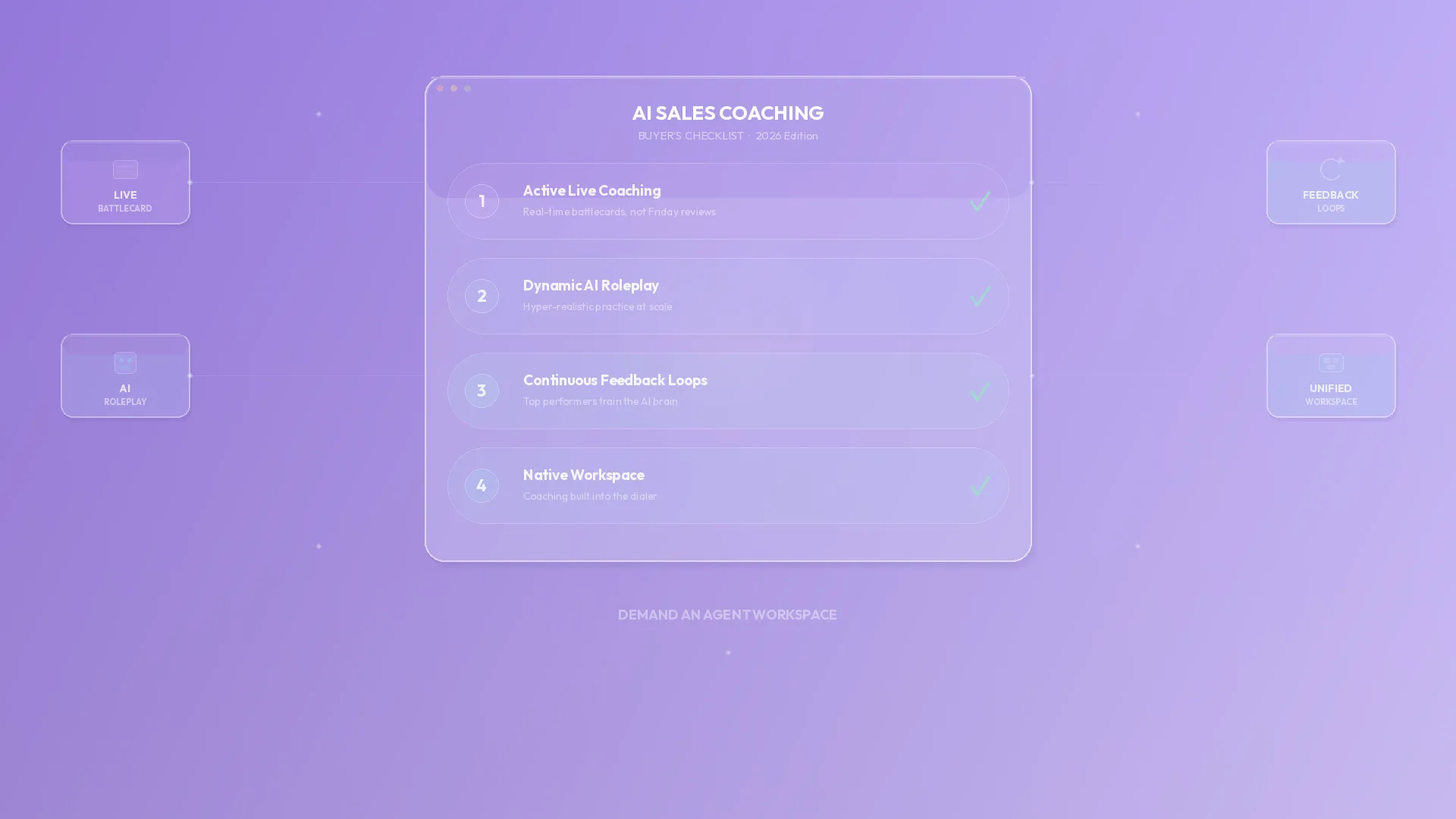
What to Look for in AI Sales Coaching Software: A 4-Point Checklist
Once you know what the category can do, here's what to actually demand from a vendor before signing a contract.
1. Active Live Coaching
The check: Does the platform support real-time guidance while a call is still happening, in addition to recording it for later review?
Post-call review is genuinely useful for spotting patterns across a rep's calls over time, and it's not going anywhere. What it can't do is change the outcome of the call it's reviewing. A platform built for active coaching adds live guidance on top of recording: a battlecard that surfaces the moment a prospect raises a known objection or mentions a competitor, not only a transcript waiting for a manager's Friday-afternoon review.
2. Dynamic AI Sales Roleplay Built From Real Calls
The check: Can new reps practice against a realistic AI buyer persona at scale, or does ramping depend on a manager's limited time running mock calls in a conference room? Look for vendors that can show a real cut in rep ramp time, not just a roleplay feature on a spec sheet.
Manager-led sales roleplay doesn't scale. A frontline manager can run a handful of practice sessions per week at most. AI sales roleplay built from real call recordings lets a new rep run dozens of practice reps in an afternoon, with instant feedback on tone and objection handling, freeing manager time for coaching that actually needs a human. See the 5 best AI sales roleplay tools for sales training for a deeper comparison of this specific capability.
3. Continuous Feedback Loops
The check: Is the platform a fixed repository of scripts and battlecards written once, or does it keep learning from what's actually working on live calls?
Static objection-handling PDFs go stale the moment the market shifts. A continuous feedback loop captures how a top rep handled a brand-new objection, then pushes that response into the shared battlecards and the roleplay agent automatically, so one rep's win becomes the whole team's training within the same day.
4. Native Platform Integration
The check: Do reps have to leave their dialer and log into a separate coaching tool to see feedback, or is coaching built into the same platform they already use to call and sequence?
A coaching tool disconnected from the dialer and sequencing tool creates real coordination overhead: a rep making a call in one window and checking feedback in another. Coaching built natively into a unified platform means the same call data that trains the roleplay agent also feeds the live battlecards, without a second login. This is the same tool sprawl problem that shows up across the rest of an SDR tech stack, not just coaching.
Real-Time vs. Post-Call Coaching: Which Do You Need?
Most teams need both, but they solve different problems.
Real-time coaching helps in the moment: a live prompt when a prospect raises pricing pushback, a battlecard that surfaces a competitor's known weakness the second that competitor's name comes up. It's most valuable for high-stakes, predictable moments in a call.
Post-call analysis goes deeper than a live prompt can: full-call talk-time breakdowns, pattern detection across dozens of calls, deal-level risk flags that only become visible after looking at the whole conversation. It's better suited to identifying trends across a rep's calls over weeks, not correcting a single moment.
The strongest AI sales coaching software does both without turning every call into a stream of interruptions that feels like surveillance instead of support. If a platform only offers one, know which gap you're accepting.
Is AI Sales Coaching Software Right for Small Teams?
Yes, and the smaller the team, the more a manager's time is the actual constraint the software needs to solve. A manager running a 4-rep team can technically review every call personally, but that leaves no time for anything else, and coaching quality still varies by whichever rep happens to get reviewed that week.
Small teams (3-5 reps) get the most value from automated call scoring and sales roleplay built into daily workflow, since it saves a solo manager from spending hours manually reviewing recordings, and a platform that scales cleanly means it doesn't need replacing once the team doubles.
Growing teams (10-20 reps), a common SDR org size, are where manual review stops being mathematically possible. This is roughly where the average manager-to-rep ratio (12.1, per Gallup) sits today, and it's the point where AI-surfaced coachable moments stop being a nice-to-have and start being the only way coaching stays consistent across the team.
Larger, multi-manager organizations need coaching software mainly for consistency: making sure skill development doesn't vary based on which manager a rep happens to report to, and giving leadership visibility across teams that no single manager's notes could provide.
Real-World Proof: Customer Results With Nooks
HubSpot: the BDR team cut ramp time 30% after moving to a coaching model where role-play is built from real calls. Brian DeRosa, VP Global Business Development.
Trends Shaping AI Sales Coaching in 2026
Real-time coaching is replacing post-call review as the default. Post-call review dominated for a decade because in-call coaching technology wasn't reliable enough to trust. In 2026, real-time prompts are accurate enough to use during a live conversation without distracting the rep, and the shift matters because behavior change happens closest to the action.
AI sales roleplay is replacing recorded call libraries for ramp. Watching a recording is passive. Roleplay built from real call data lets new reps practice the actual objections their team hears, with the AI pushing back like a real prospect instead of reading from a script.
Manager-coachability scoring is emerging as a triage layer. With managers overseeing 12.1 reps on average, tracking which reps actually change their behavior after a coaching moment (versus which ignore it) is becoming its own metric, so managers can spend deep coaching time where it moves the needle instead of spreading thin across everyone equally.
Coaching and execution are converging into single platforms. Buyers increasingly want a coaching insight to update a sequence step or a messaging template directly, closing the loop between what a manager notices and what the team does next, rather than treating coaching and execution as two disconnected systems.
Demand for call intelligence and coaching is climbing together, not one at the other's expense. The conversation intelligence software market is projected to grow from $28.54 billion in 2025 to $32.25 billion in 2026, a 13% CAGR (Conversation Intelligence Software Global Market Report), a sign teams are investing more in both call visibility and coaching, not swapping one for the other.
How to Evaluate AI Sales Coaching Software for Your Team
Beyond the 4-point checklist above, weigh these before signing:
CRM automation. Does the platform auto-log call summaries and update CRM fields, or does that fall on the rep to do by hand afterward? Nooks treats Salesforce as the source of truth, with calls and outcomes written back directly rather than sitting in a separate system a rep has to check.
Integration with your dialer and sequencing tools. A coaching platform that requires stitching together with a separate dialer and sequencing tool adds coordination overhead a small team feels immediately and a large team feels in fragmented reporting.
Budget and time to ROI. Enterprise conversation intelligence platforms and lighter, lower-cost coaching tools solve overlapping problems at very different price points. Track rep ramp time and call-to-meeting rate rather than waiting for a single quota number to move; most teams see the first real behavior signal within four to six weeks, with measurable quota impact over a full quarter.
Inbound or outbound fit. Many conversation intelligence platforms were built around inbound AE calls: discovery, demos, deal inspection. Confirm a platform was actually built for your team's motion (outbound SDR volume looks different from inbound AE deal review) before assuming a well-reviewed tool fits your workflow.
The Short Version
AI sales coaching software analyzes calls, live or recorded, and turns that analysis into real-time guidance, AI roleplay built from real conversations, and feedback loops that push a top rep's winning response into training for the whole team. The category splits into post-call analysis, real-time guidance, and roleplay, and most legacy tools only do the first. What separates a strong platform from a passive one is whether it actively coaches reps in the moment and whether that coaching lives in the same system reps already use to call and sequence.
If your team is evaluating whether your current coaching stack is actually changing rep behavior or just filing away recordings, request a demo to see how Nooks AI Coaching works on your own calls, or read our full Nooks coaching software review for a feature-by-feature breakdown against other platforms.