What is a Power Dialer? (And Why Speed Alone Isn't Enough)

.avif)
If you have ever spent a day cold calling manually, you know the grueling rhythm of the job. You look at a spreadsheet, type ten digits into your desk phone or softphone, listen to it ring, hit a voicemail, hang up, log the note in your CRM, and then pause.
That 30-second pause between calls is where sales floors lose their momentum. Reps get distracted, check their email, or succumb to call reluctance. To solve this friction, sales operations leaders historically turned to one foundational piece of technology: the power dialer.
Upgrading to power dialer software is often the first major operational leap a growing outbound team makes. It solves the velocity problem by completely eliminating the manual keypad.
But as buyer fatigue reaches all-time highs, simply dialing faster is no longer enough to generate pipeline. Here is exactly what a power dialer is, why it is a necessary upgrade, and why the most successful teams are pairing this high-speed engine with an AI-driven intelligence layer to actually close deals.
What is a Power Dialer? (The Definition)
A power dialer is a piece of sales telephony software that automatically dials the next contact on a rep’s list the exact moment the previous call ends and the seller is ready.
Unlike a parallel dialer (which dials multiple numbers simultaneously), a power dialer operates on a 1-to-1 ratio. It calls one prospect at a time. However, it removes all the manual friction between those calls. When a rep logs in and hits "start," the system dials Prospect A. If Prospect A doesn't answer, the rep clicks a disposition code (like "Left Voicemail"), and the software instantly begins dialing Prospect B.
Auto Dialer vs. Power Dialer: What's the Difference?
When evaluating telephony tools, buyers often get confused by the terminology, specifically auto dialer vs power dialer.
- The Auto Dialer: Traditionally used in B2C call centers, an auto dialer blasts thousands of numbers at once and routes answered calls to the first available agent. This often results in a tell-tale "telemarketer delay"—that awkward two-second silence before the agent realizes someone picked up.
- The Power Dialer: Built for B2B sales professionals. The rep is already on the line, assigned to a specific, targeted list. When the prospect answers, the rep is immediately there, ready to speak without any robotic delays.
The Velocity Advantage: The "Flow State"
There is a reason power dialers became a staple of modern sales tech stacks: they support execution.
When you remove the physical act of typing numbers and tabbing between screens, you unlock the SDR "Flow State."
A power dialer is a phenomenal engine for velocity. But an engine only dictates how fast you are moving—it doesn’t dictate if you are driving in the right direction.
The Trap: Why Speed Without Context is Dangerous
This is where many scaling revenue teams make a critical error. They purchase a power dialer, load up a massive, static list of 1,000 cold prospects from their data provider, and tell their reps to hit "start."
What happens next? The reps certainly dial faster, but their connect rates and meeting-booked rates plummet.
Velocity without relevance is a liability. If you feed your power dialer a terrible, un-researched list of bad numbers, you aren't just burning through your TAM at record speed—you are actively destroying your domain reputation and getting your numbers flagged as "Scam Likely" by carriers.
Furthermore, when a power dialer drops a rep into a live conversation with zero context, the rep is forced to guess. They don't know if the prospect is actively hiring, if they just raised funding, or if they use a competitor's software. Blinded by speed, the rep defaults to a generic, template-driven pitch. The prospect hangs up, and the dialer ruthlessly moves on to the next victim.
The Evolution: Power Dialing Meets the AI Agent Workspace
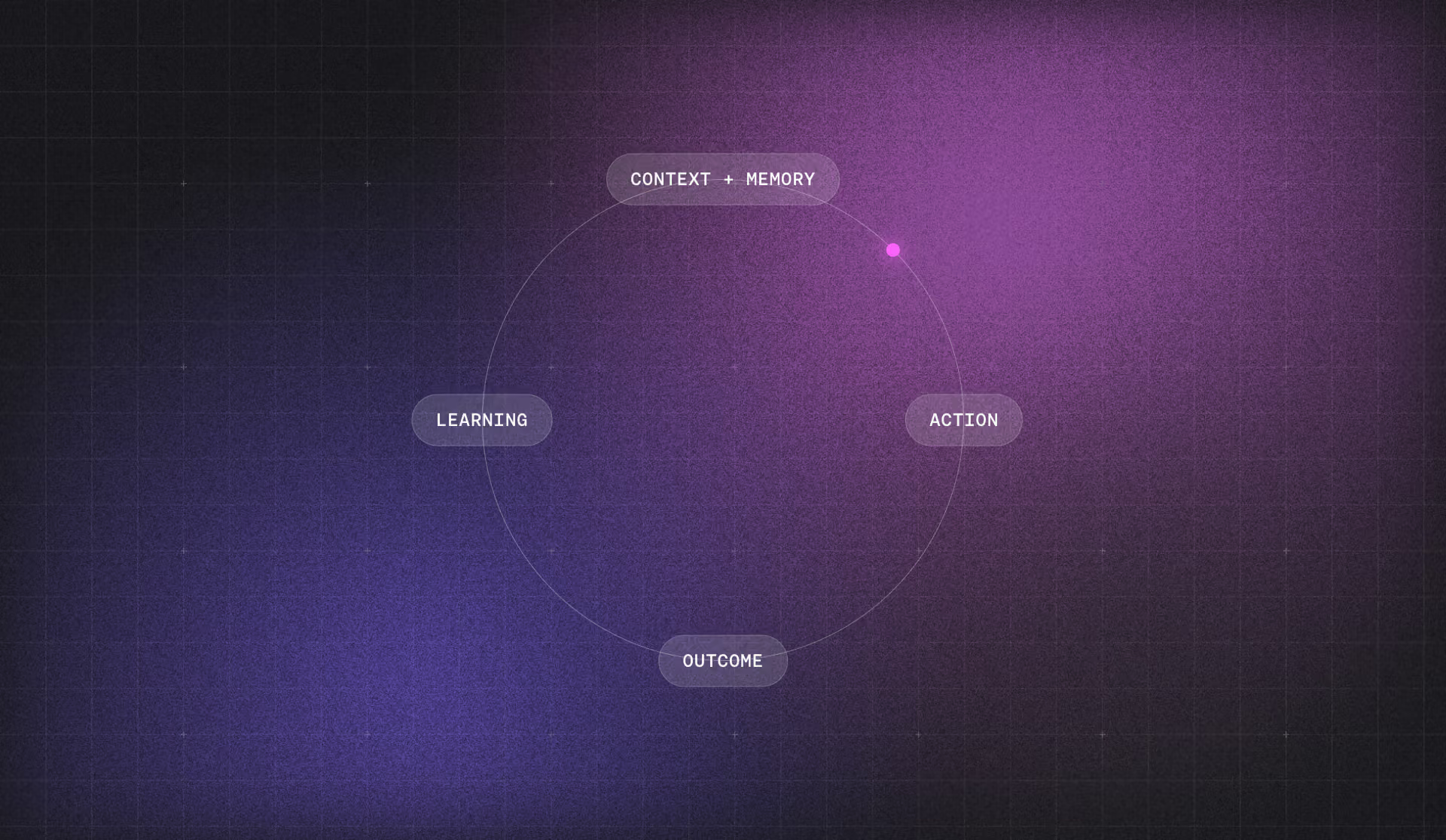
To build a modern sales prospecting motion, you do not need to abandon the power dialer. You need to upgrade it. You must wrap that high-speed dialing engine in an AI-driven intelligence layer.
This is the shift from a basic telephony tool to a complete Agent Workspace. Here is how modern teams combine speed with strategy:
1. Dynamic, Signal-Based Feeding
Instead of loading a static list of 1,000 random names, an AI Agent Workspace feeds the power dialer dynamically. Overnight, AI scans your target accounts for observable buying signals (like a new job posting or an executive change). In the morning, it automatically routes those high-priority targets to the top of the dialer queue. You still get the speed of a power dialer, but every call is hyper-relevant.
2. Just-In-Time Waterfall Enrichment
A fast dialer is useless if it's constantly hitting corporate switchboards or disconnected lines. Before the dial is even initiated, a modern workspace automatically "waterfalls" the prospect's data across multiple third-party providers. This ensures the dialer is armed with a verified, direct mobile number, maximizing your live connect rates.
3. Automated Spam Protection
High-volume dialing inherently carries the risk of carrier filtering. An intelligent dialer actively monitors your phone number health across the telecom ecosystem. It can automatically rotate local presences and provide spam protection to ensure your calls actually show up cleanly on the prospect's caller ID, protecting your reputation while you scale.
4. In-Context Insights & Live Battlecards
When the power dialer initiates the ring, the AI instantly surfaces the buying signals and rich account insights right on the screen. The rep doesn't have to scramble across LinkedIn tabs. Even better, if the prospect answers and mentions a competitor or common objection, the AI detects it and pops up live battlecards. The rep gets the exact talk tracks they need to pivot the conversation flawlessly in real-time.
5. Native CRM Automation
A power dialer loses all its efficiency if the rep still has to pause the campaign for three minutes to manually type call notes into Salesforce. Modern workspaces use AI to automatically transcribe the call, generate a summary, and log the disposition directly to the CRM natively. The rep hangs up, the AI logs the data, and the dialer moves to the next number instantly.
Conclusion: Upgrade Your Engine
Upgrading from manual dialing to a power dialer is a mandatory step for any growing sales organization. It eliminates friction, crushes call reluctance, and guarantees list penetration.
But speed alone will not save a broken outbound strategy.
If you are evaluating power dialer software today, demand more than just a telephony connection. Demand an Agent Workspace that combines the relentless velocity of a dialer with the strategic intelligence of AI, spam protection, and real-time enablement. Empower your reps to dial fast, but ensure they are always equipped with the exact context they need to actually book the meeting.