

Nooks CMO Loreal Lynch on the GTM Now podcast: how AI is changing sales teams

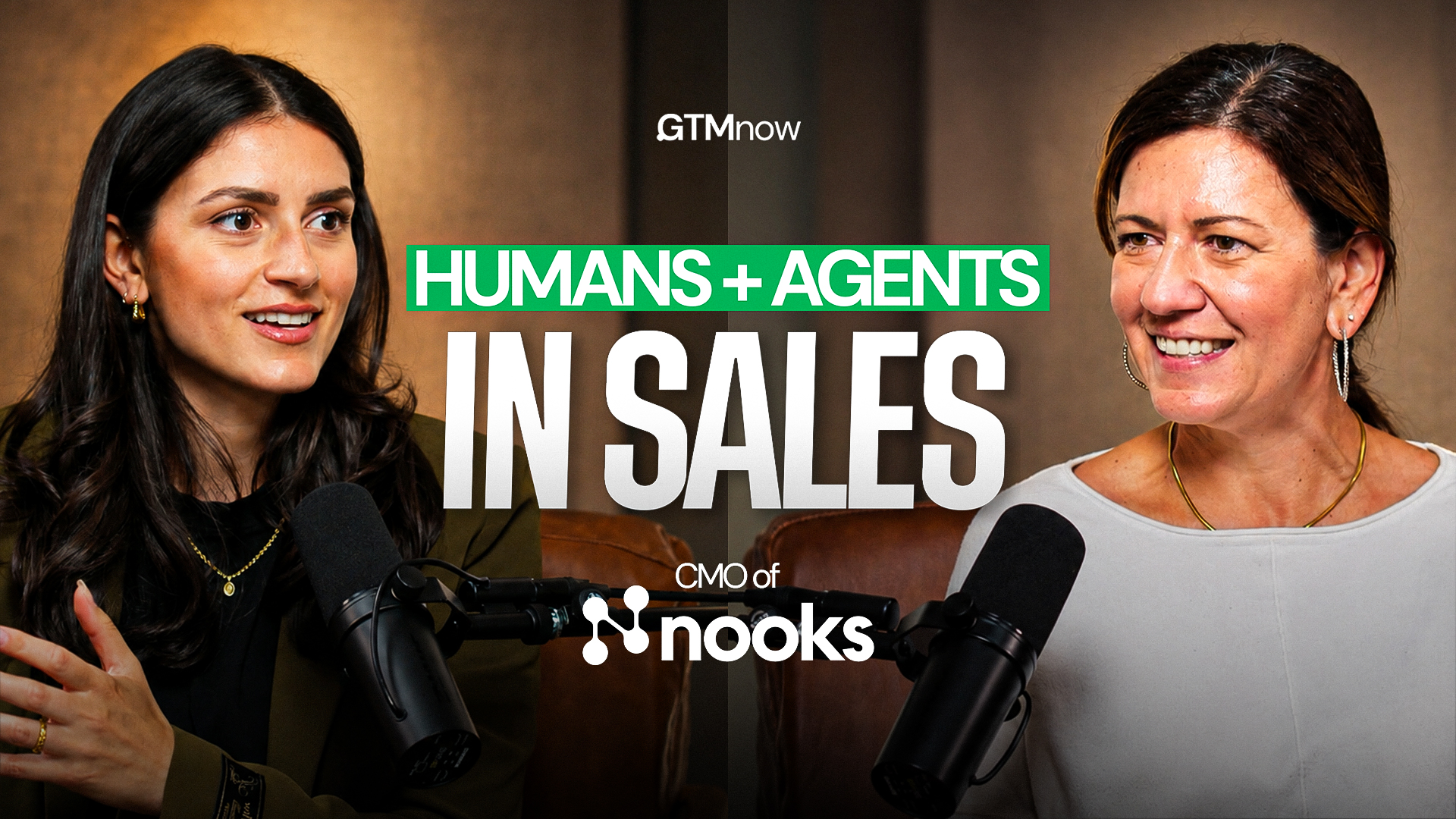
Our CMO went on GTM Now. Four takeaways from someone who bought Nooks before she ran marketing for it.
I've sat through enough "AI in sales" panels this year to recite them from memory. Agents will do the grunt work. Reps will focus on relationships. Everyone nods. (I nod too. It's not wrong.) What's usually missing is someone who has actually run an SDR team on this stuff and can tell you what changed.
That's why Loreal's GTM Now episode is worth a few minutes of your week. Before she joined Nooks as CMO in August, she was CMO at Jasper, where she also ran the SDR team and brought in Nooks. She's been the customer and it shows.
Short version first, then the four things worth tuning into.
TL;DR
- The interesting question is who's prompting whom. Today the rep prompts the AI. Loreal expects that to flip in the next year or two.
- 10x productivity is a hiring argument. Nooks customers see 3x meetings booked and 2x pipeline on the same headcount. Her take: hire more, grow faster.
- The hard part of agents is everything underneath them. One agent is easy to build. Shared data, governance and dialing infrastructure across a sales org is where teams get stuck.
- Kill the sourced-pipeline target. Marketing and sales at Nooks run one enterprise pipeline number. Both are on the hook.
1. Stop counting agents per rep
The host opens with Dan's iceberg analogy from his own episode earlier this year: humans above the waterline, agents below, and the line keeps moving. The natural follow-up is a ratio question. How many agents per human by 2028?
Loreal answers with a sales call from her onboarding. Enterprise deal, head of RevOps on the other end, and he very clearly did not want to be there. Our AE read it in the first thirty seconds, saw the guy was in Florida, mentioned he used to live there and asked if he surfed. Tone changed.
"That's something that an agent could never do. On the other hand, agents are really good at reasoning. They're very good at processing information, distributing information, scaling that information."
Then she gets to the part we keep thinking about. The agents we're building learn from the reps they work alongside, and at some point they know enough to give the instructions.
"It's going to get to the point where the AI is actually prompting the rep. Do this. Go call this person. Do this after the meeting to help accelerate this deal."
She puts that a year or two out. The host had been thinking about it as a volume question. Loreal's point is that the direction of the prompt matters more than the count.
2. 10x productivity is a hiring argument
The word "automation" makes people hear "layoffs." Loreal's response:
"If you have an agent that's able to make a rep 10x more productive, why would you get rid of reps? Why would you not just double or triple the number of reps and grow that much faster?"
Her precedent is engineering. Coding tools got good, and companies hired more engineers because each one could ship more. Across Nooks customers, the number today is 3x meetings booked and 2x pipeline on existing headcount. The customers she names (Cursor, Deel, HubSpot) are AI-native companies that were willing to redesign the process instead of bolting a tool onto the old one, and she thinks that's why they got there first.
She's also careful about what that number is. It's what customers see today, with the dialer and the sales engagement platform we launched this year. The agent-prompts-the-rep phase is still ahead. I appreciated that she didn't blur the two.
3. The hard part of agents is everything underneath them
Ask Loreal what the market gets wrong and she doesn't hesitate: people think agents are easy to build. Self-serve tools make one agent trivial. Write a prompt, save it, now you have account research.
"It might be easy to build an individual agent, but scaling that across an entire go-to-market organization is much more challenging."
What "scaling" means in practice: shared data, shared context, governance, and then the unglamorous execution layer. Email deliverability. Calling and dialing infrastructure. LinkedIn outreach. RevOps leaders get this immediately, she says, because they've lived it.
There's a second half to the point at 8:42. You can't take an AI-native tool and apply it to your old process. The process has to be rebuilt around it, which is the harder organizational work and the reason AI-native companies adopted first.
4. Kill the sourced-pipeline target
If you've been in the meeting where marketing says "we sent you the leads" and sales says "they weren't any good," this section is for you. Loreal and Hannah Willson, our CRO, don't split enterprise pipeline into marketing-sourced and sales-sourced. One number. Both accountable.
"It doesn't really matter who sourced it. Rather than having sourced targets for our enterprise business, we just have a shared pipeline goal that we're both held accountable to."
Her reasoning is that enterprise cycles make sourcing a fiction anyway. An inbound form, then a dinner, then an exec connects on LinkedIn, then someone reads a case study. Her word for arguing over which touch counts is "counterproductive."
The weekly pipeline call then becomes: where are we against the number by segment and region, and what closes the gap. Sometimes a campaign. Sometimes there's nothing marketing can do and sales needs an exec in the deal. She says that part out loud.
Also worth your time
- 20:26: why the pendulum is swinging back from performance marketing to brand, when every vendor in the category is saying "we have agents that automate your process."
- 22:37: revenue agents as a category nobody has defined yet, and why she bet on Nooks to do it after watching it happen at Salesforce, Tableau and Stripe.
- 24:53: why the dialer was the right wedge (a confined pilot is an easier first yes than a platform).
- 25:57: rapid fire. Be yourself. Don't over-index on activity, it's about impact. There's no time for bad wine.
What I'd steal
- Run one pipeline number for a quarter. See what your pipeline meeting turns into when nobody's defending a sourced column.
- Before you build an agent, list what it needs underneath. Data, context, governance, deliverability, dialing. If the list is long, you have your build-vs-buy answer.
- Find the spots where your reps prompt the tool today. Those are the ones Loreal's describing when she says the direction flips.