
The RevOps Guide to Revenue Intelligence: Why Outbound Data is the Missing Link


Every Revenue Operations professional knows the ultimate promise of revenue intelligence. The goal is to capture, aggregate, and analyze data across all customer interactions to build highly predictable forecasting models and spot pipeline risks before deals fall apart.
You buy an expensive platform to analyze deal stages, map stakeholder engagement, and track conversation metrics. But for most RevOps teams, there is a massive, frustrating blind spot. The top of the funnel is completely dark.
Companies spend heavily on analyzing bottom of funnel discovery calls and demos. Meanwhile, their top of funnel outbound motion remains a total black box.
If your outbound strategy is built on a fragmented tech stack, your revenue intelligence platform is starving for data. You cannot build an accurate revenue model on top of missing inputs. Here is how modern RevOps leaders are using unified outbound platforms and AI agents to fix their data hygiene and finally unlock true revenue intelligence.
The RevOps Nightmare: The Fragmented Outbound Stack
To understand why outbound data is so critical to revenue intelligence, you have to look at the daily workflow of your sales development team.
In a standard setup, the outbound stack is a nightmare of disjointed tools. Reps bounce between a standalone dialer, a separate AI email writer, a third party intent data provider, and a generic sequencing tool.
For RevOps, a fragmented stack means broken data. When reps jump between five different tools, activity logging becomes manual. Reps forget to log their dials. They fail to update disposition codes accurately. They manually push the wrong notes into the CRM. Data silos are created, and the CRM rapidly decays into a mess of incomplete records.
When your revenue intelligence tool tries to analyze the origin of your pipeline, it hits a wall. You might know why a deal closed in Q4, but you have zero visibility into how that high intent prospect was actually found in Q1. You do not know what initial pain point got them on the hook, which specific AI buying signal triggered the outreach, or which multi-channel sequence actually performed best.
Without clean top of funnel data, your forecasting models will always be flawed.
Fixing the Blind Spot with a Unified Execution Layer
Buying another analytics dashboard will not fix a broken data collection process. If you want pristine data for your revenue intelligence platform, you have to fix the workflow where the data is actually generated.
You need a unified execution layer. This is exactly why we built the Nooks Agent Workspace.
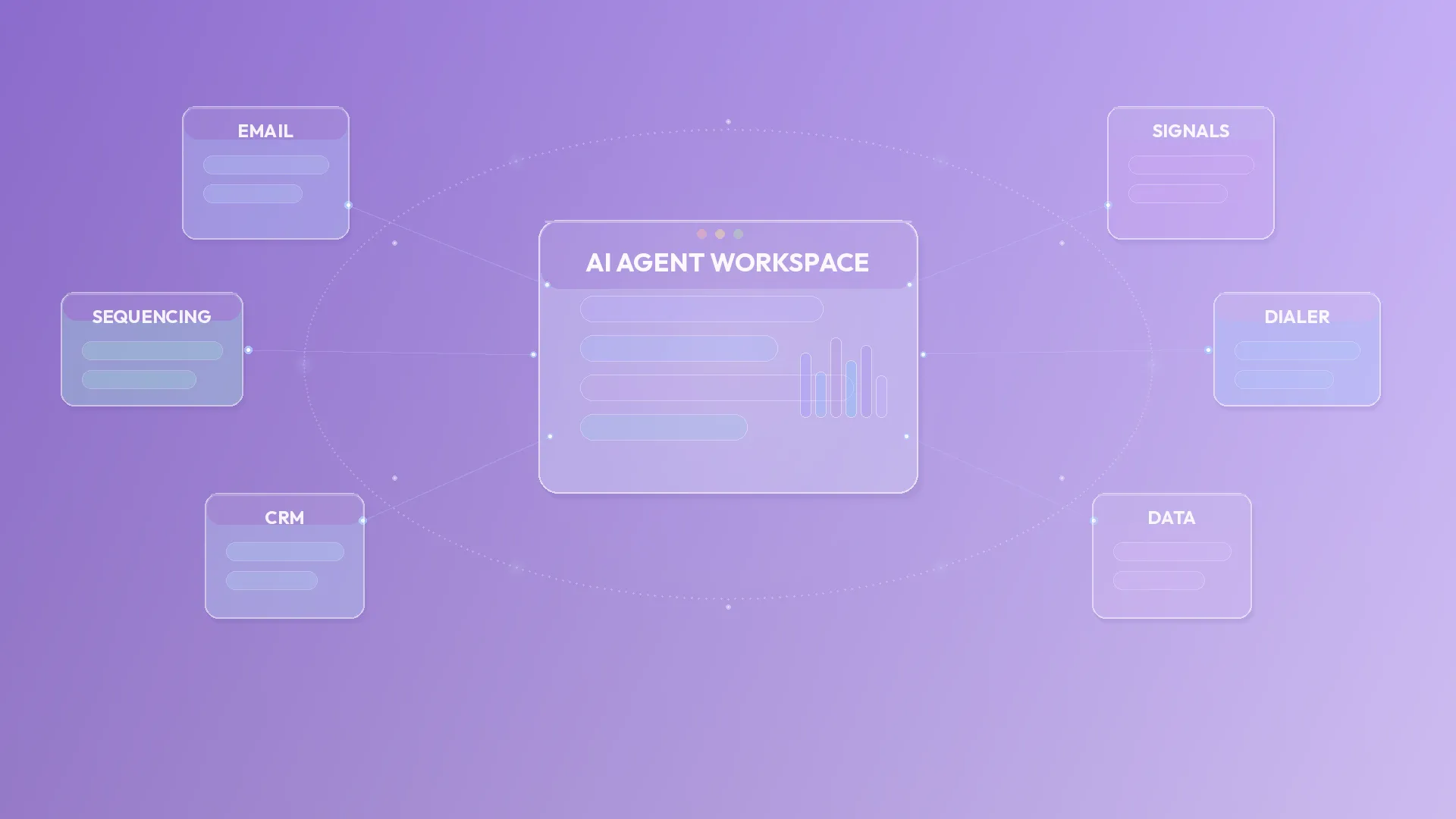
Instead of forcing reps to act as manual data entry clerks, the Agent Workspace brings the entire outbound motion into a single window. It unifies AI prospecting signals, smart sequencing, and parallel dialing into one command center. By eliminating the friction of tool switching, you eliminate the gaps in your data collection.
More importantly for RevOps, the Nooks Agent Workspace is built around a bi-directional CRM sync. Every single action taken inside Nooks syncs natively with your CRM. Every dial, every email reply, and every disposition code is captured perfectly in real time.
There is no manual logging required. The CRM remains your single source of truth, and your revenue intelligence platform finally gets the complete, uninterrupted feed of top of funnel activity it needs to do its job.
How AI Agents Drive Richer Conversational Data
Clean activity metrics like dial counts and open rates are only the baseline. True revenue intelligence requires deep, qualitative conversational data.
If your reps are making blind cold calls without any account context, the resulting conversations will be incredibly shallow. The rep will default to a generic feature pitch, the prospect will immediately put their guard up, and the call will end in under forty seconds. When your revenue intelligence platform analyzes that short transcript, the only insight it will generate is a bounce rate.
Great outbound data requires deep account context. This is where AI agents completely transform the top of the funnel.
Within the Nooks Agent Workspace, AI agents handle the heavy lifting of prospecting and account research. The AI continuously scans the market for critical buying signals, like new executive hires or tech stack changes. It automatically enriches contacts with verified direct dials.
Before a rep makes a call, the AI Account Assistant synthesizes your messy CRM data and pairs it with real time market signals to provide a clear, actionable brief.
When a rep makes a dial using Nooks, they are armed with perfect context. They know exactly what recent company news to reference and what specific pain point to target. Because the rep leads with context, the prospect actually opens up. The call transforms from a quick rejection into a five minute strategic conversation about business challenges, current vendors, and timeline.
Now, when your revenue intelligence software analyzes that call transcript, it has a goldmine of data to work with. It can accurately map competitor mentions, identify shifting market trends, and uncover deep buyer insights. Better outbound execution literally gives your revenue intelligence platform smarter data to analyze.
Securing the Foundation of Revenue Intelligence
You cannot manage a revenue engine if the inputs are garbage.
RevOps teams are constantly tasked with finding the leaks in the pipeline. But if you cannot track the lifecycle of an account from the very first buying signal to the final booked meeting, your analysis will always be incomplete.
By letting AI agents handle the account research, data syncing, and consolidating your outbound stack into the Nooks Agent Workspace, you solve the data integrity problem at the source. You give your reps the context they need to book high quality meetings, and you give your revenue intelligence platform the pristine, full funnel visibility it needs to actually predict revenue.